
Ceramic Export Customs Procedures In Vietnam And Essential Documents For Importers
Navigating ceramic export customs procedures in Vietnam requires strict adherence to complex international legal regulations. Submitting a highly accurate set of export documents guarantees rapid clearance, completely eliminating costly demurrage charges at the destination port.\
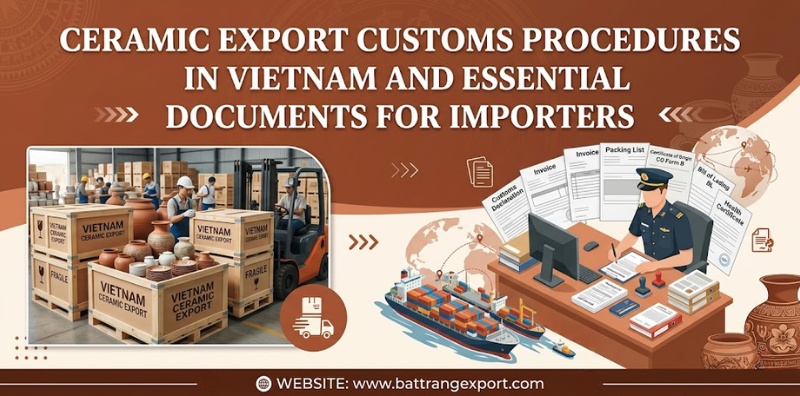
Understanding this legal framework is essential for B2B importers to ensure their wholesale cargo remains fully compliant. Therefore, Bat Trang Ceramic Factory provides this comprehensive guide detailing all mandatory shipping paperwork to facilitate a highly efficient and secure international procurement process.
Essential Export Documents Required by Vietnamese Customs
Executing a successful international shipment relies heavily on preparing a flawless set of mandatory administrative paperwork. Consequently, the manufacturer and the designated freight forwarder must submit the following core documents to Vietnamese customs authorities:
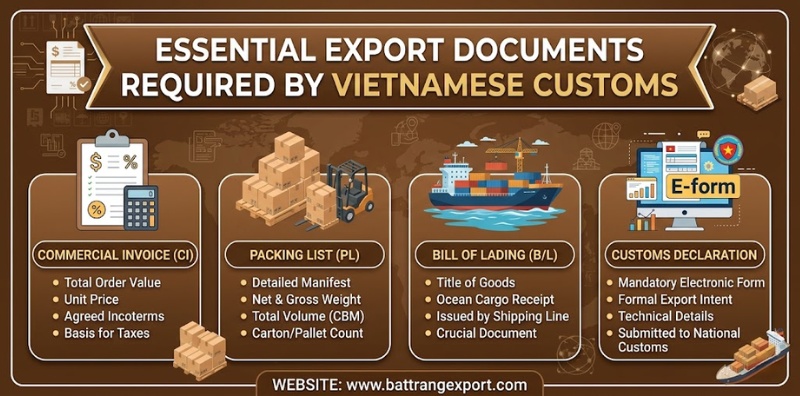
- Commercial Invoice (CI): This legally binding document declares the total order value, the exact unit price, and the agreed Incoterms, serving as the definitive basis for calculating import taxes.
- Packing List (PL): This detailed manifest specifies the exact net weight, gross weight, total volume (CBM), and the precise number of cartons or wooden pallets loaded inside the container.
- Bill of Lading (B/L): Issued directly by the shipping line, this crucial document acts as the official title of goods and the ultimate receipt of ocean cargo transfer.
- Customs Declaration: This is the mandatory electronic form submitted directly to the national customs system, formally declaring the export intent and technical details of the merchandise.
Certificate of Origin (C/O) and Import Tax Optimization
Because the Vietnamese government has strategically established numerous Free Trade Agreements (FTAs) with the top global markets for importing Vietnamese ceramics, securing the correct Certificate of Origin (C/O)—such as Form EUR.1 or Form CPTPP—allows international buyers to leverage these legal frameworks, drastically reducing or completely eliminating import duties at their destination.
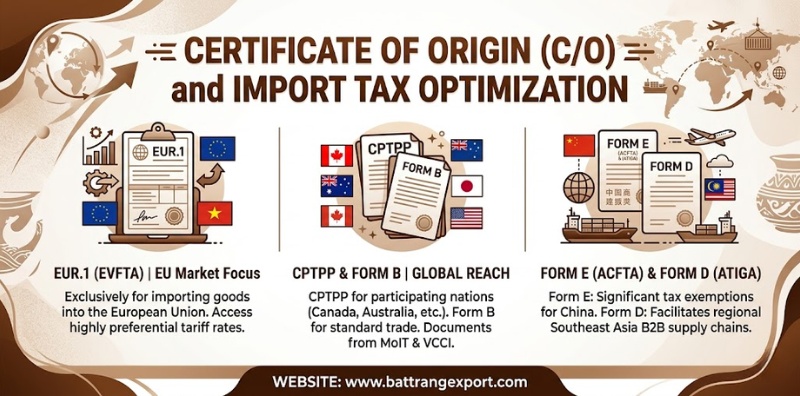
- Form EUR.1 (EVFTA): This specific certificate applies exclusively to clients importing goods into the European Union. Utilizing this document allows buyers to benefit from highly preferential tariff rates under the EU-Vietnam Free Trade Agreement.
- Form CPTPP or Form B: The CPTPP form serves participating nations like Canada and Australia, whereas Form B acts as the standard non-preferential certificate for countries without specific agreements, such as the United States. Bat Trang Ceramic Factory proactively applies for these documents through the Ministry of Industry and Trade (MoIT) or the Vietnam Chamber of Commerce and Industry (VCCI).
- Form E (ACFTA) and Form D (ATIGA): Form E is utilized for exports to China, granting significant tax exemptions under the ASEAN-China Free Trade Area. In addition, Form D is mandatory for shipments within Southeast Asian nations, optimizing regional B2B supply chains.
Mandatory ISPM-15 Fumigation for Ceramic Packaging
Because pottery is inherently fragile, instructing the factory on exactly how to securely package ceramic orders for export to prevent breakage is a critical prerequisite. This requires securing heavy corrugated cartons onto robust wooden pallets, establishing a heavy-duty infrastructure that systematically prevents severe structural damage during turbulent maritime transit.
However, international agricultural laws strictly dictate that all raw wooden packaging materials must undergo rigorous pest control treatments. Therefore, suppliers must execute standardized fumigation procedures and physically stamp the wood to prove absolute compliance with the global ISPM-15 standard.
Failing to provide a valid Fumigation Certificate will cause immediate legal complications upon arrival at the destination port. Specifically, international customs authorities will forcefully detain the container, impose heavy financial fines, or mandate the complete destruction of the non-compliant packaging.
Quality Certifications for the US, EU, and Japanese Markets
Beyond standard shipping paperwork, highly regulated markets demand rigorous proof of chemical safety. Therefore, importers must secure specific compliance certificates demonstrating that the tableware contains absolutely no hazardous heavy metals.
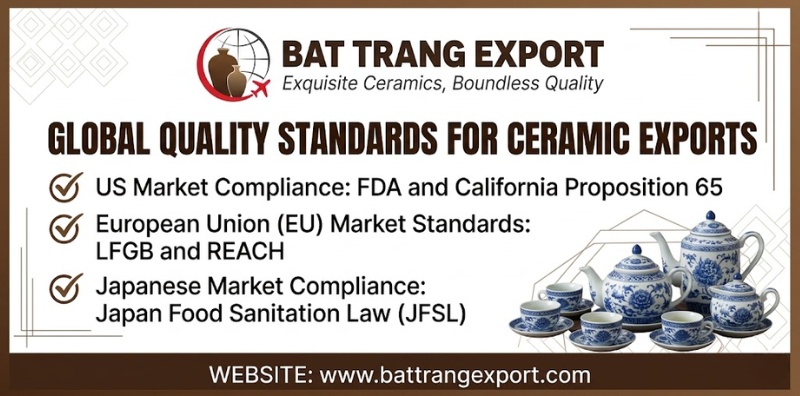
- FDA and California Proposition 65 (US): Mandates strict laboratory testing to ensure zero lead and cadmium leaching from food contact materials.
- LFGB and REACH (EU): Requires comprehensive migration tests to guarantee the pottery does not transfer toxic chemicals into food or the environment.
- JFSL (Japan): Enforces high-temperature acidic extraction tests to meet the strict hygiene parameters of the Japanese Ministry of Health.
Understanding the exact chemical limitations of these specific regional laws is critical for preventing customs rejection. Importers must proactively verify their shipments against strict global quality standards for ceramic exports, ensuring that thorough laboratory testing procedures confirm absolute US, EU, and Japan compliance regarding lead and cadmium migration.
Understanding HS Codes for Ceramic Products
The Harmonized System (HS) code is a standardized numerical method used by customs authorities worldwide to classify traded products. Identifying the exact tariff classification dictates the specific import duty rates and legal regulations applied to your cargo.
Submitting an inaccurate HS code on your customs declaration can lead to severe legal consequences. Consequently, incorrect classification often triggers unexpected financial penalties, mandatory physical inspections, and prolonged clearance delays at the border.
To guarantee absolute accuracy, procurement managers must utilize the correct classifications found within Chapter 69. Below are the most common HS codes assigned to exported pottery from Vietnam:
- HS Code 6907: Applies to unglazed ceramic flags, paving, hearth, or wall tiles.
- HS Code 6911: Specifically designates tableware, kitchenware, other household articles, and toilet articles manufactured from porcelain or china.
- HS Code 6912: Categorizes tableware, kitchenware, other household articles, and toilet articles made from standard ceramics or earthenware, excluding porcelain.
- HS Code 6913: Encompasses statuettes and other ornamental ceramic articles, including decorative interior vases.
- HS Code 6914: Covers all other miscellaneous ceramic products not explicitly detailed in the preceding classifications.
The Step-by-Step Customs Clearance Process in Vietnam
Executing the physical clearance process at major Vietnamese ports, such as Hai Phong or Cat Lai, requires methodical coordination. Freight forwarders navigate this complex logistical phase through the national electronic declaration system.
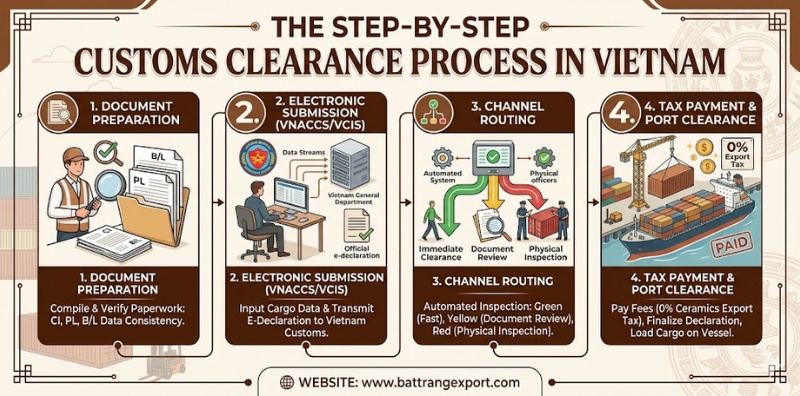
- Document Preparation: The logistics team thoroughly compiles and cross-verifies all previously mentioned paperwork, ensuring absolute data consistency across the CI, PL, and B/L.
- Electronic Submission (VNACCS/VCIS): Customs brokers input the exact cargo data into the specialized software. Subsequently, they transmit the official electronic declaration directly to the Vietnam General Department of Customs.
- Channel Routing: Within minutes, the automated system assigns a specific inspection channel. The Green channel grants immediate clearance, the Yellow channel requires a detailed manual review of the physical paperwork, and the Red channel mandates a strict physical inspection of the cargo at the port.
- Tax Payment and Port Clearance: Because the export tax rate for finished ceramics is currently 0%, forwarders only pay minor administrative fees. After liquidating the declaration, the container is officially approved and loaded on board the vessel.
Critical Precautions for Ceramic Customs Declarations
Preventing administrative bottlenecks requires extreme attention to detail during the documentation phase. Procurement teams must enforce the following critical precautions to guarantee an uninterrupted export procedure.
- Absolute Document Consistency: This remains the most common administrative error in international logistics. Every piece of data regarding product names, exact quantities, total weights, and financial values must match 100% across the Commercial Invoice, Packing List, Bill of Lading, and the Certificate of Origin.
- Clear Merchandise Descriptions: The declaration must explicitly state the material composition, the exact intended usage, and the manufacturing method. Providing this high level of clarity prevents disputes when customs officers determine the final HS code application.
- Accessible Packaging for Physical Inspections: If the system triggers a Red channel routing, officers will randomly open specific cartons for verification. Therefore, manufacturers must design robust packaging that is secure for transit but easily resealable without damaging the internal fragile goods.
How Bat Trang Ceramic Factory Simplifies Your Logistics
Understanding the severe logistical challenges international importers face, Bat Trang Ceramic Factory seamlessly integrates customs clearance into a highly structured, professional ordering process for bulk ceramic exports. By providing comprehensive, end-to-end supply chain solutions, we operate not only as a premium manufacturer but also as a highly reliable logistical partner dedicated to accelerating your global distribution.
Our dedicated export department meticulously drafts, verifies, and finalizes the complete A-Z set of shipping documents. Furthermore, we provide expert consultation on exact HS code classifications, strategically optimizing your import duties and enhancing your overall commercial competitiveness.
In addition, our facility directly manages all mandatory legal procedures, proactively securing the necessary Certificates of Origin and ISPM-15 Fumigation Certificates. By coordinating seamlessly with reputable freight forwarders and major shipping lines, we secure the most competitive ocean freight rates for our global buyers.
In conclusion, mastering export customs procedures becomes completely seamless when partnering with a legally proficient manufacturer. Bat Trang Ceramic Factory consistently executes flawless documentation protocols to ensure your wholesale cargo crosses international borders without costly delays. Contact our dedicated logistics team today to request a comprehensive quotation and streamline your next major B2B import project.