
OEM vs. ODM in Ceramic Manufacturing: Which is Right for Your Brand?
In the competitive landscape of the ceramic industry, choosing the right manufacturing model: OEM or ODM directly impacts your budget, production timeline, and overall brand identity. An Original Equipment Manufacturer (OEM) builds products entirely based on your unique designs, whereas an Original Design Manufacturer (ODM) provides pre-existing templates for you to private label.
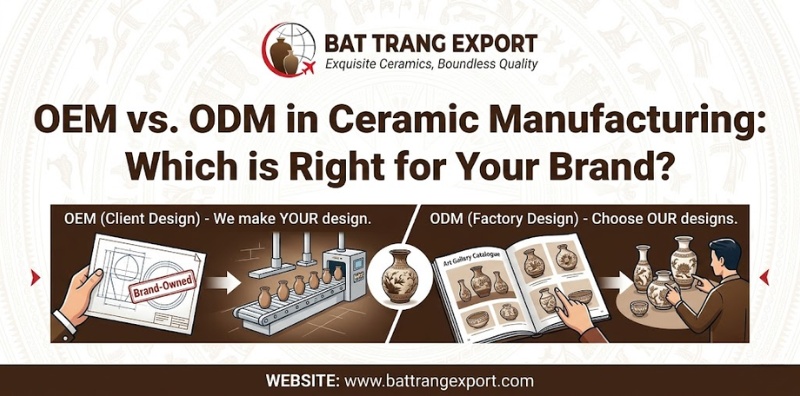
Understanding the fundamental distinction between these two approaches is crucial for optimizing your supply chain and achieving a faster time-to-market. Therefore, Bat Trang Export will analyze the critical differences between Original Equipment Manufacturer (OEM) and Original Design Manufacturer (ODM) protocols to help you make highly informed supply chain decisions.
What is OEM in Ceramic Manufacturing?
In the context of ceramic production, OEM requires the client to provide comprehensive technical drawings, CAD or 3D models, pattern blueprints, and specific glaze formulations. Upon receiving the Tech Pack, the factory creates custom plaster molds to manufacture the bespoke pottery precisely according to the requested dimensions and material specifications.
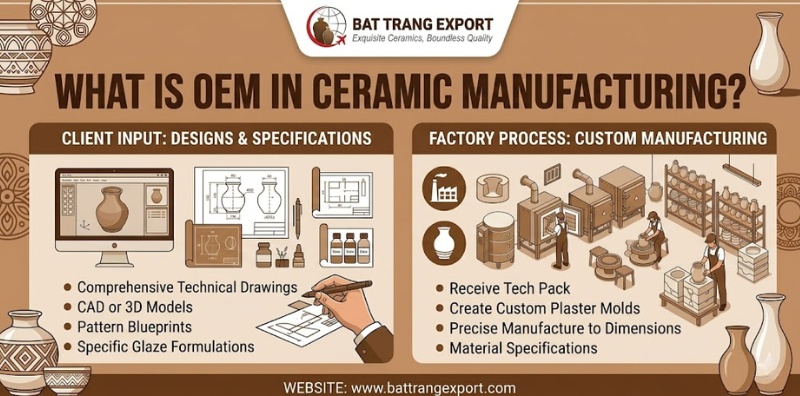
Developing a custom ceramic line from scratch offers significant control over the final output, but it also demands a heavier initial investment. Before committing to this comprehensive manufacturing route, consider the following advantages and disadvantages:
Pros of OEM Production:
– Complete Intellectual Property (IP) Ownership: You retain 100% exclusive rights to your custom molds, ensuring highly unique products that competitors cannot duplicate.
– Strict Quality and Spec Control: Brands can dictate the exact clay body, firing temperature, and glaze finish to build a distinct competitive advantage in the retail market.
Cons of OEM Production:
– High Initial Molding Costs: Developing custom plaster molds and conducting extensive R&D requires significant upfront capital.
– Extended Development Timelines: Prototyping, kiln testing, and sampling naturally extend the lead time before mass production can begin.
– Higher Minimum Order Quantities (MOQ): Factories typically require larger volume commitments to justify the complex setup and tooling processes.
Choosing the OEM route means you have full control over the design, but it also requires a deeper understanding of the entire ceramic manufacturing process, from 3D mold creation to the final firing stage, to ensure your custom designs are feasible for mass production.
What is ODM in Ceramic Manufacturing?
The ODM model, frequently referred to as white-labeling or private labeling, utilizes the factory’s existing catalog of ready-made designs. For instance, clients can select pre-developed mugs, dinner plates, or vases from Bat Trang Export, and then request specific glaze colors or custom overglaze decal printing to reflect their brand identity.
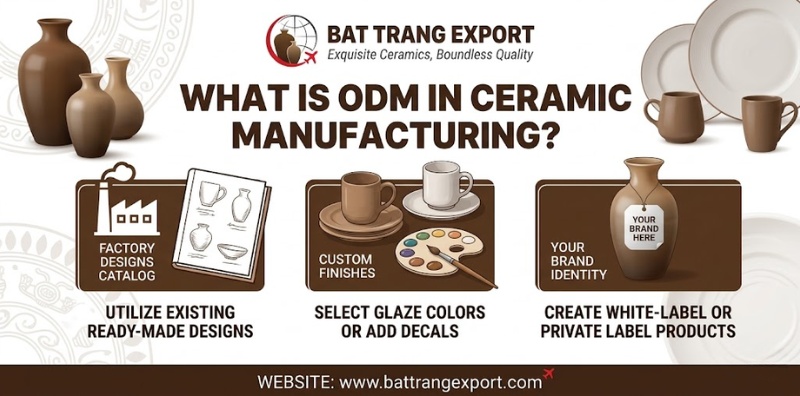
For brands opting for ODM, the focus shifts from product design to brand personalization. Factories offer various ceramic logo printing techniques, such as fired decals or UV DTF, allowing you to seamlessly apply your branding onto their ready-made blanks.
Opting for an existing ceramic shape is an excellent strategy for businesses looking to launch quickly and minimize sourcing risks. However, this convenience comes with certain limitations regarding product exclusivity:
Pros of ODM Production:
– Fast Time-to-Market: Production can commence almost immediately, drastically reducing the time between order placement and inventory delivery.
– Zero Tooling or Molding Fees: Since the plaster molds already exist in the factory’s inventory, clients avoid all R&D and setup costs.
– Lower Minimum Order Quantities: Manufacturers can process smaller batches, making it ideal for testing new markets.
Cons of ODM Production:
– Lack of Complete Exclusivity: Other brands may purchase and customize the exact same base ceramic shape from the factory.
– Limited Structural Customization: While surface treatments like dipping glaze and decals are flexible, altering the fundamental dimensions or core structure of the pottery is not possible.
OEM vs. ODM: Core Differences in Pottery Production
Navigating the technical and commercial distinctions between custom and private-label pottery requires a clear side-by-side evaluation. The table below outlines the core differences to help procurement managers and brand owners make an informed sourcing decision.
| Feature | OEM (Custom Design) | ODM (Private Label) |
| – Product Design | Design Created by the Client | Created by the Factory |
| – Mold Cost | High (Custom molds required) | None (Using existing molds) |
| – Time-to-Market | Slower (Requires prototyping) | Faster (Ready to produce) |
| – IP Ownership | Client owns the copyright | Factory owns the product shape |
| – Best For | Brands with unique product visions | Brands wanting quick sales & low budget |
Key Factors to Consider When Choosing Your Manufacturing Model
Selecting the most profitable manufacturing route requires a thorough assessment of your company’s current operational capabilities. Furthermore, analyzing your financial resources and market positioning will ensure a seamless partnership with your chosen ceramic supplier.
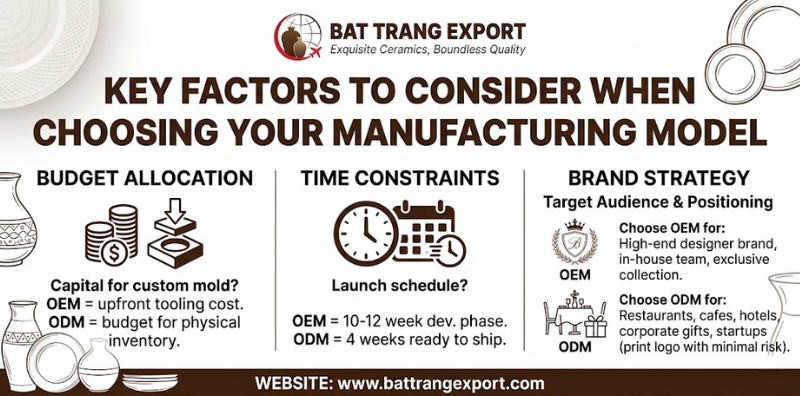
– Budget Allocation: Do you have the capital for custom mold development? OEM requires upfront investment in prototyping and tooling, whereas ODM allocates your entire budget directly to the physical inventory.
While ODM involves lower initial investments, OEM requires paying upfront for custom molds and R&D. Understanding how factories calculate export ceramic prices will help you evaluate which sourcing model aligns best with your brand’s budget and profit margins.
– Time Constraints: Assess your product launch schedule carefully. Do you need finished ceramics ready to ship in 4 weeks utilizing an ODM approach, or can your business accommodate a 10 to 12-week development phase for a rigorous OEM project?
– Brand Strategy and Market Positioning: Your target audience dictates the necessary level of customization.
Choose OEM if: You operate a high-end designer brand with an in-house design team. This model is perfect if you possess a strong R&D budget and want to launch a highly exclusive, unrepeatable collection of ceramic shapes.
Choose ODM if: You run a restaurant, cafe, hotel chain, or corporate gifting company. In addition, startups looking to print their logo on standard porcelain mugs and plates with minimal financial risk will find this model highly beneficial.
The choice between these two models heavily depends on your sales platform. For instance, private label Amazon sellers sourcing ceramics often prefer ODM to quickly test market demand, whereas high-end boutique brands usually invest in OEM for exclusive shapes.
Why Choose Bat Trang Export for Your Custom Ceramic Needs?
Finding a reliable supplier capable of executing precise technical specifications is essential for international buyers. Bat Trang Ceramic Factory is an established industry leader that consistently delivers premium export ceramics, fully supporting both bespoke OEM projects and rapid ODM orders.
– Strict Confidentiality: We guarantee the protection of your intellectual property by signing a comprehensive Non-Disclosure Agreement (NDA) for all OEM designs. Your blueprints and custom glaze formulas remain strictly confidential throughout the entire production cycle.
– Robust Production Capacity: Our facility combines high-volume firing capabilities with the expertise of master mold makers. Besides custom engineering, we maintain a vast library containing thousands of ready-made ODM templates to accelerate your private label production.
Frequently Asked Questions (FAQs)
International B2B buyers often have specific technical inquiries regarding custom pottery sourcing. Below are the answers to the most common questions concerning our manufacturing protocols and order requirements.
Q1: Can I apply my own custom glaze colors to an ODM ceramic product?
Yes, in ODM, while the shape is pre-designed, you can often customize the glaze color, finish, and add your logo via decal printing.
Q2: Do I have to pay for the mold in OEM production?
Yes, creating custom plaster molds for your unique design incurs a one-time development fee. However, the molds belong to your project exclusively.
Q3: What is the typical Minimum Order Quantity (MOQ) for OEM vs. ODM ceramics?
Typically, OEM requires a higher MOQ to offset mold setup costs (1000-3000 pcs), whereas ODM can accommodate lower MOQs since the molds already exist. Exact numbers depend on the product complexity.
In conclusion, deciding between OEM and ODM ceramic manufacturing ultimately depends on your specific goals regarding exclusivity, budget constraints, and project deadlines. Bat Trang Ceramic Factory possesses the technical expertise and manufacturing scale to bring your unique vision to the global market efficiently. Contact our team today with your Tech Pack or browse our extensive catalog to receive a competitive wholesale quotation!