
The 7-Step Professional Ordering Process For Bulk Ceramic Exports
The bulk ceramic export ordering process involves a tightly coordinated sequence of 7 steps between the manufacturer and the international importer to guarantee quality, adherence to schedules, and legal compliance.
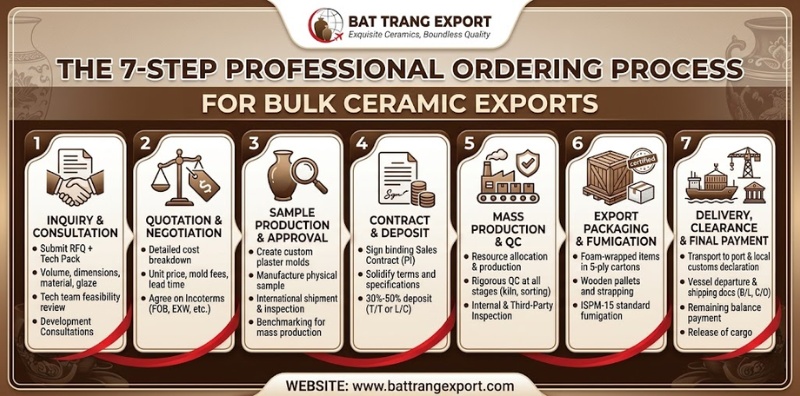
Implementing a standardized workflow at Bat Trang Export systematically eliminates supply chain risks while maintaining rigorous cost control. Consequently, this professional approach ensures that large-scale pottery shipments arrive safely at their destination ports without unforeseen delays.
Step 1: Inquiry Reception & Initial Consultation
The sourcing procedure officially begins when a client submits a detailed Request for Quotation (RFQ) accompanied by a comprehensive Tech Pack. This initial documentation must specify the estimated order volume, exact dimensions, required clay material, glaze color, liquid capacity, and the intended export market.
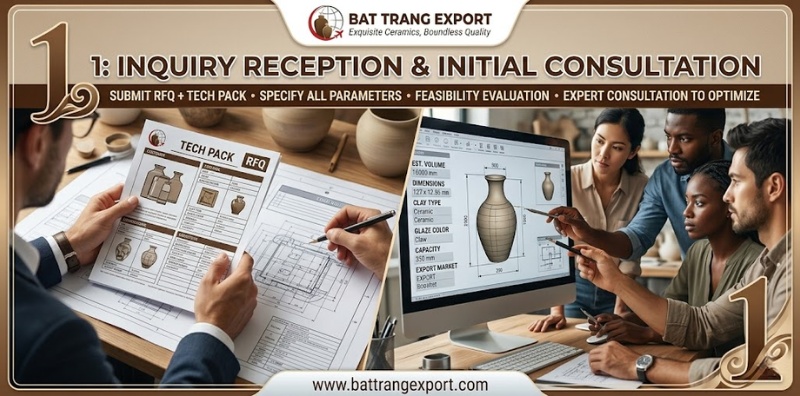
Upon receiving these technical specifications, the engineering team evaluates the manufacturing feasibility of the proposed design. Furthermore, they provide expert consultation to adjust certain parameters, ensuring structural integrity while optimizing overall production costs.
Step 2: Quotation & Negotiation
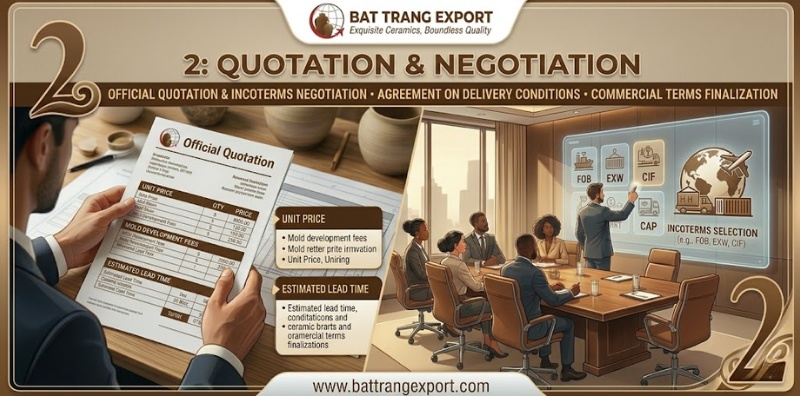
After finalizing the technical parameters, the manufacturer issues an official quotation detailing the breakdown of all associated costs. This commercial proposal clearly outlines the unit price, mold development fees, and the Estimated Lead Time required for project completion.
When you receive the initial quote from the manufacturer, it’s crucial to understand the variables involved. Reviewing the breakdown of export ceramic pricing—which includes raw materials, mold fees, and labor—will help you negotiate effectively and avoid hidden costs.
Subsequently, both parties enter a negotiation phase to agree upon the most suitable delivery conditions for the transaction. Buyers typically select standard Incoterms such as FOB, EXW, CIF,….depending on their specific logistics capabilities and freight forwarding preferences.
Step 3: Sample Production & Approval
Once the preliminary terms are settled, the facility proceeds to create custom plaster molds and manufactures a physical sample for client evaluation. This prototype is then shipped internationally, allowing the buyer to conduct a direct, tactile inspection of the product.
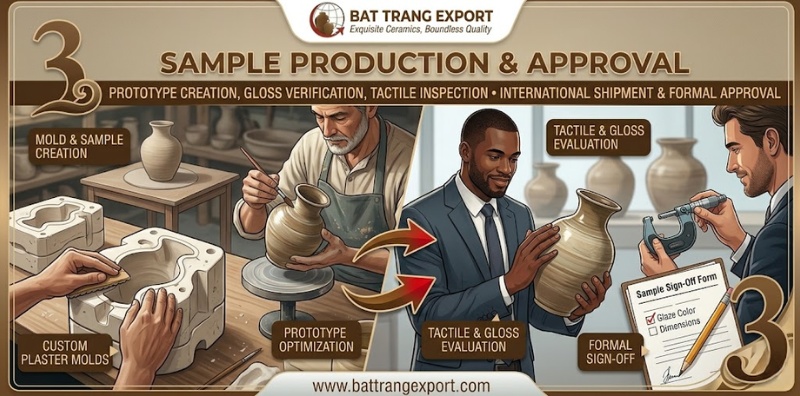
During this evaluation, the client verifies the accuracy of the dimensions, the consistency of the glaze color, and the overall surface finish. If the prototype meets all quality expectations, the buyer signs off on the sample, establishing the exact benchmark for the upcoming mass production phase.
Step 4: Contract Signing & Deposit Payment
To formalize the partnership, both the importer and the supplier sign a legally binding Sales Contract or a detailed Proforma Invoice (PI). This document solidifies all previously negotiated commercial terms, technical specifications, and delivery schedules.
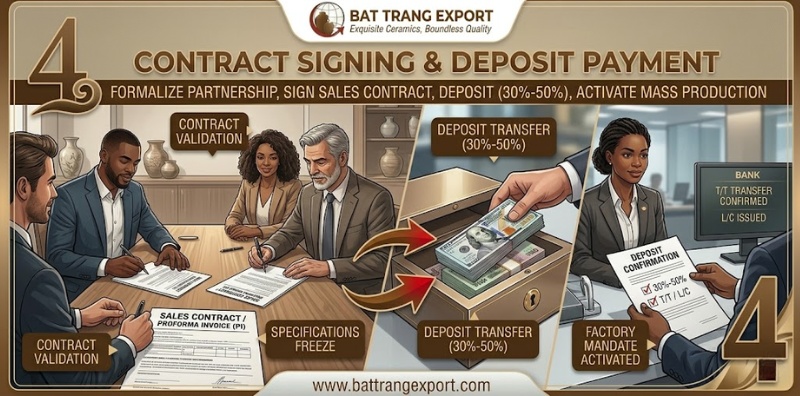
Following the signature, the client issues the required deposit, which generally ranges from 30% to 50% of the total order value. Buyers usually execute this transaction via Telegraphic Transfer (T/T) or a Letter of Credit (L/C), officially activating the factory’s mass production mandate.
Step 5: Mass Production & Strict Quality Control
Once the pre-production sample is approved and the deposit is transferred, the factory initiates mass production. Having a clear overview of the complete ceramic manufacturing process allows importers to set realistic lead time expectations for casting, glazing, and firing stages.
Especially, throughout this phase, an internal Quality Control (QC) team rigorously monitors every stage, starting from clay mixing and shaping to the critical high-temperature kiln firing.
Careful supervision during the kiln unloading process ensures that any pieces with cracking or glaze defects are promptly identified and discarded. Therefore, only items that pass strict visual and structural assessments proceed to the packaging department.
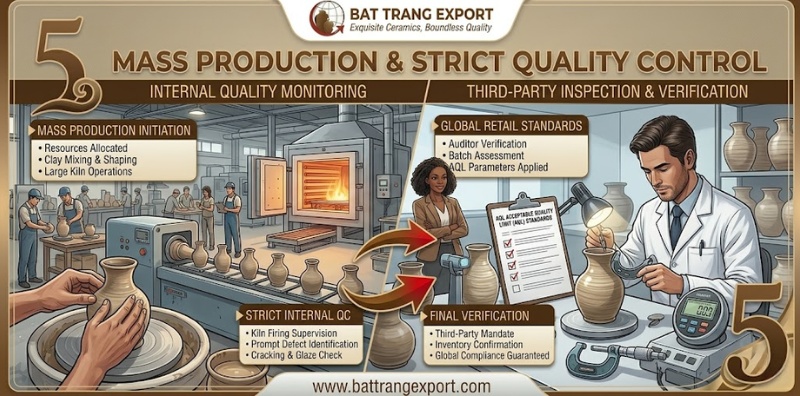
During and after production, rigorous quality control is mandatory. Before authorizing the final shipment, you must ensure that your products strictly comply with the global quality standards for ceramic exports, particularly regarding lead and cadmium limits required by US FDA or EU regulations.
International buyers can mandate a third-party inspection agency to verify the inventory before shipment. These external auditors assess the batch according to standard Acceptable Quality Limit (AQL) parameters to guarantee complete compliance with global retail standards.
Step 6: Export-Standard Packaging & Fumigation
After passing the quality inspection, the goods move to the packing facility. Because pottery is highly fragile, specifying the correct method for packaging export ceramics to prevent breakage—such as using custom bubble wrap, inner boxes, and sturdy palletizing—is vital to protect your investment during ocean transit.
Specifically, workers carefully wrap each individual piece in protective foam before placing them into heavy-duty, 5-ply corrugated cartons.
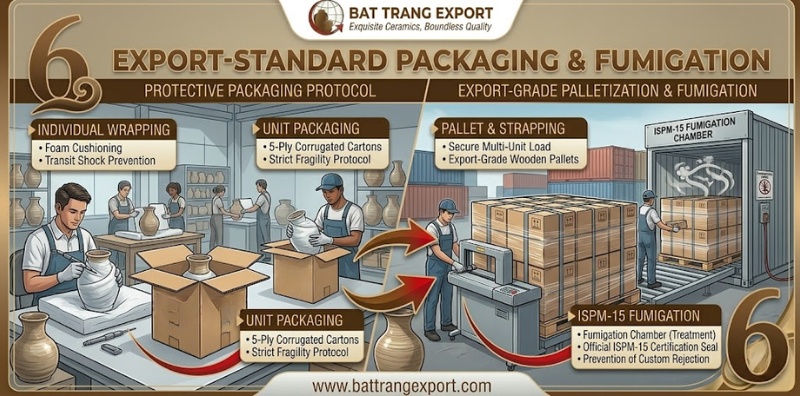
These cartons are then securely stacked and strapped onto export-grade wooden pallets to ensure stable container loading. Crucially, all wooden packaging materials must undergo proper fumigation to meet the ISPM-15 standard, thereby preventing rejection by customs authorities at the destination port.
Step 7: Delivery, Customs Clearance & Final Payment
The final step involves booking the freight, settling the balance, and preparing the commercial documents. Familiarizing yourself with Vietnam’s ceramic export customs procedures, including the Bill of Lading and Certificate of Origin, ensures a smooth handover to your freight forwarder and prevents delays at the loading port.
Upon completing the packaging process, logistics providers transport the fully loaded shipping container directly to the designated departure port. Simultaneously, the manufacturer handles the local export customs declaration to legally clear the goods for international maritime transit.
After the vessel departs, the factory issues a draft Bill of Lading (B/L) alongside other vital shipping documents, such as the Certificate of Origin (C/O) and the Packing List. The buyer reviews these documents thoroughly to ensure all data aligns perfectly with the initial order requirements and customs regulations.
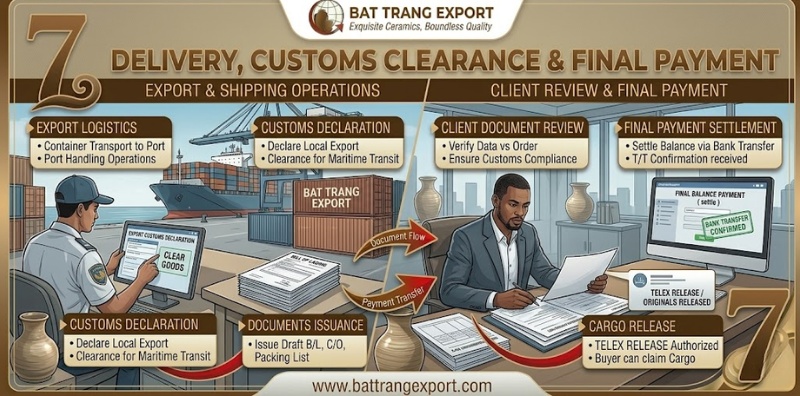
Finally, the importer settles the remaining financial balance via bank transfer. Upon receiving the final payment, the factory authorizes the release of the B/L—either by surrendering original documents or issuing a Telex Release—enabling the buyer to claim their cargo upon arrival.
Estimated Lead Times for Bulk Ceramic Orders
The overall production schedule heavily depends on the structural complexity of the custom design and the total order volume. Understanding the standard timeframes allows international B2B buyers to effectively align their inventory planning and product launch strategies. The typical lead times for wholesale manufacturing are broken down as follows:
– Prototyping & Sampling: 7 to 15 days. This duration fluctuates based on whether the factory utilizes an existing ODM template or must engineer an entirely new custom plaster mold.
– Mass Production: 30 to 45 days. This core manufacturing phase officially begins immediately after the factory receives the T/T deposit and the final physical sample approval.
– Ocean Freight (Shipping): 15 to 35 days. Transit times vary significantly depending on whether the destination port is located in Asia, Europe, or North America.
Breakage Policy and Risk Management
Despite implementing rigorous export-standard packaging protocols, inherent risks remain when transporting fragile cargo across rough ocean conditions. Consequently, a minor breakage rate of 1% to 2% is generally considered an acceptable industry standard during maritime shipping. To mitigate financial losses for buyers, the factory enforces a clear and systematic risk management policy:
– Evidence Collection: Importers must take detailed photographs and record video footage immediately while unloading the container to document any transit damage clearly.
– Replacement Credit: For verified damaged items, the manufacturer issues a production credit, replacing the broken units free of charge in the client’s subsequent bulk order.
– Direct Invoice Deduction: Alternatively, if no future orders are scheduled, the factory can calculate the exact value of the broken goods and deduct that amount directly from the final balance or issue a proportional refund.
Adhering to a highly structured ordering process guarantees that international B2B buyers receive premium, fully compliant ceramics on schedule. By executing every step meticulously, from the initial technical consultation to the final customs clearance, your supply chain remains transparent and fully optimized. Contact Bat Trang Export Factory today with your technical specifications to receive a competitive quotation and start your customized manufacturing project.