
How to Package Ceramic Orders for Export to Prevent Breakage
Packaging export ceramics requires a robust multi-layer protection system to neutralize severe maritime shocks and unpredictable physical impacts. Consequently, executing a professional structural engineering process remains absolutely critical for global B2B importers to systematically eliminate devastating breakage rates.
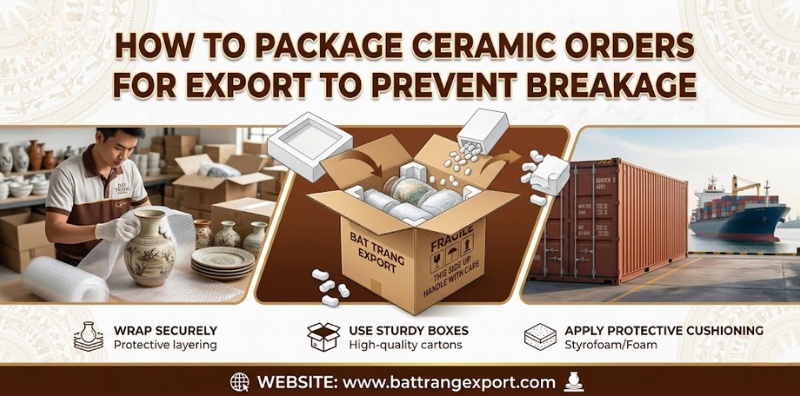
In this comprehensive guide, Bat Trang Ceramic Factory meticulously outlines the industry-standard packaging protocols for fragile merchandise. Therefore, applying these precise logistical strategies ensures your valuable wholesale cargo arrives securely at the destination port without incurring catastrophic financial losses.
The 3-Layer Ceramic Export Packaging System
Securing fragile commodities for international transit demands a highly systematic approach to structural reinforcement. B2B buyers must implement a standardized three-layer packaging architecture to guarantee maximum cargo integrity throughout the global supply chain.
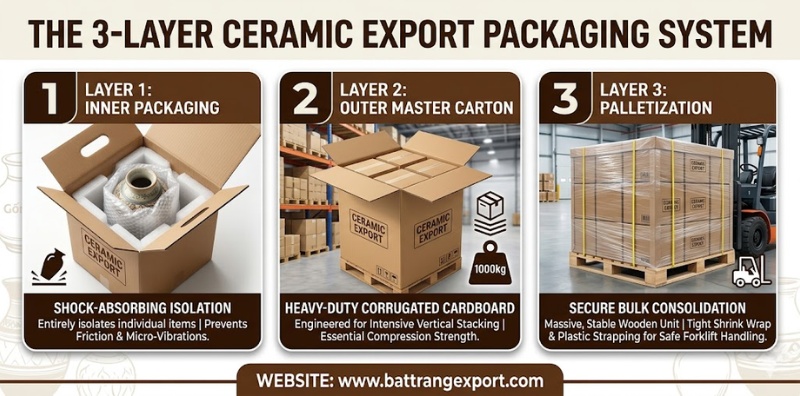
- Layer 1: Inner Packaging: This initial protective barrier utilizes shock-absorbing materials to isolate individual items entirely. Specifically, it prevents item-to-item friction and neutralizes internal micro-vibrations during extended commercial transportation.
- Layer 2: Outer Master Carton: This secondary shield consists of heavy-duty corrugated cardboard engineered for intensive vertical stacking. Furthermore, it provides the essential compression strength required to protect the internal boxes from severe external crushing forces.
- Layer 3: Palletization: This final logistical layer securely consolidates the master cartons into a massive, stable wooden unit. Consequently, applying tight shrink wrap and plastic strapping locks the bulk volume for safe industrial forklift handling.
Layer 1: Inner Packaging – Absorbing Micro-Impacts And Friction
The fundamental principle of fragile logistics dictates that ceramic items must never physically touch each other. Therefore, establishing a reliable internal protective barrier systematically absorbs continuous mechanical vibrations during turbulent ocean transit.
Factory technicians meticulously wrap every individual product utilizing high-density plastic bubble wrap. In addition, this tightly secured wrapping isolates the smooth glaze surface, completely eliminating the severe risk of destructive internal friction.
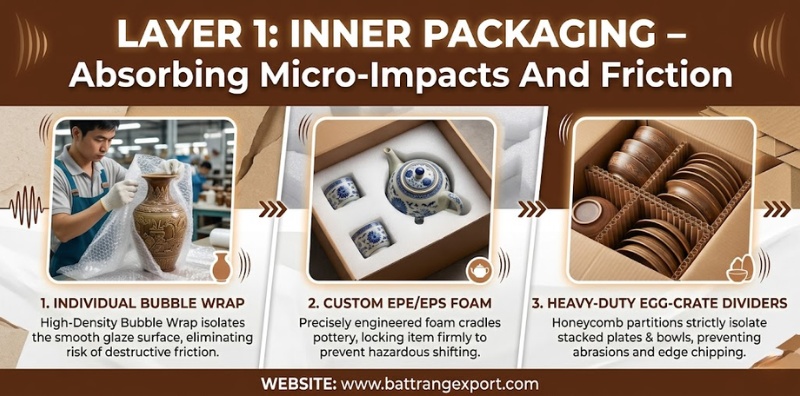
For premium high-end export orders, manufacturers deploy customized die-cut EPE foam or molded EPS foam inserts. Specifically, these precisely engineered foam structures cradle the pottery, locking the item firmly in place to prevent any hazardous internal shifting.
When exporting commercial dinnerware, logistics teams frequently implement heavy-duty egg-crate dividers within the internal boxes. Consequently, these honeycomb cardboard partitions strictly isolate stacked plates and bowls, actively preventing severe structural abrasions and unwanted edge chipping.
Layer 2: Outer Packaging – Heavy-Duty Corrugated Master Cartons
The external master carton must independently support immense vertical weight when stacked tightly inside a commercial shipping container. Therefore, utilizing 5-ply to 7-ply double-wall corrugated cartons remains an absolute necessity to secure all bulk ceramic export shipments.
These heavy-duty cardboard walls provide exceptional compression strength, directly shielding the fragile cargo from external crushing hazards. Furthermore, manufacturers must rigorously evaluate the packaging materials using a standardized edge crush test (ECT) to verify their absolute structural integrity.
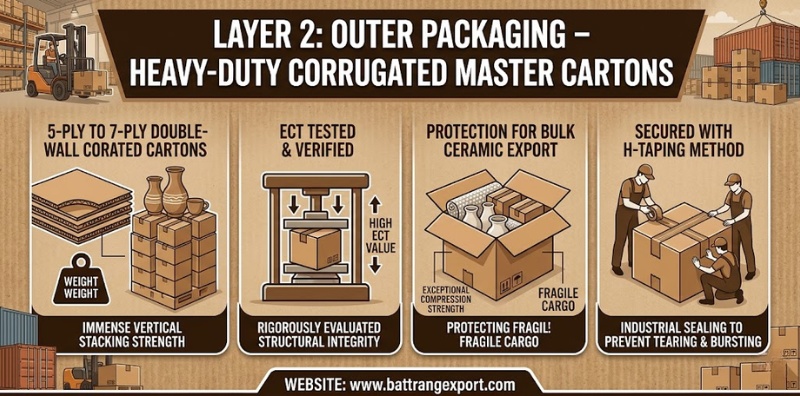
Securing the master carton properly requires specific industrial sealing techniques to prevent accidental structural failure. Specifically, warehouse personnel must utilize the H-taping method to seal the top and bottom carton flaps completely.
Applying strong adhesive tape in this specific H-pattern effectively locks all open seams against environmental moisture and tearing. Consequently, this meticulous sealing protocol ensures the heavy carton will never burst open under the intense physical pressure of global transit.
Layer 3: Secure Palletization And ISPM-15 Fumigation Compliance
Executing the palletization phase correctly secures thousands of individual master cartons into a single, immovable logistical unit. This crucial consolidation process allows warehouse operators to load heavy export containers safely utilizing standard industrial forklifts.
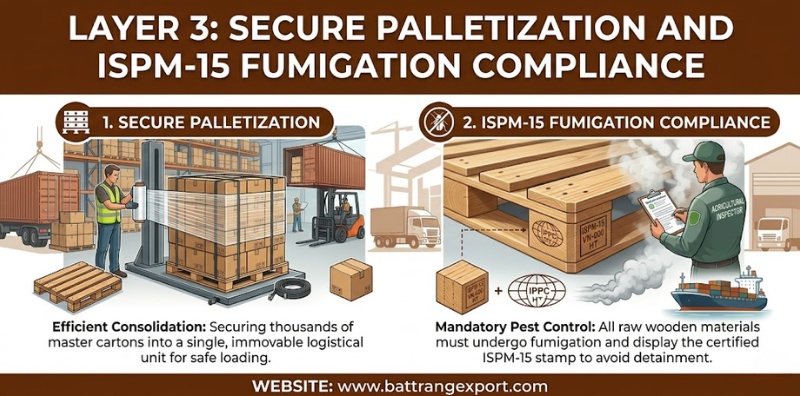
However, utilizing raw wooden materials for international shipping introduces strict global agricultural regulations. Therefore, procurement managers must strictly monitor the preparation of these wooden bases to prevent severe legal consequences at the destination port.
- Stacking and Wrapping: Technicians stack the master cartons using an interlocking pattern to lock the overall mass securely. Subsequently, they apply rigid edge protectors, heavy-duty stretch film, and tight PET strapping to create a completely rigid, immovable structure.
- ISPM-15 Compliance: Every wooden pallet must undergo mandatory chemical fumigation and display a highly visible ISPM-15 certification stamp. If this specific pest control stamp is missing, destination customs authorities will immediately detain the cargo or destroy the entire container to prevent ecological contamination.
Validating Protection: The ISTA 3A Drop-Test Standard
Verifying the true effectiveness of an export packaging system requires subjecting the cartons to aggressive simulated transit shocks. Consequently, international supply chains rely heavily on the standardized ISTA 3A drop-test to empirically validate the structural protection of the cargo.
This rigorous industrial testing protocol—which is an absolute prerequisite when sourcing Bat Trang ceramics for Amazon FBA and Etsy—involves dropping a fully loaded master carton from a height of 80 to 100 centimeters to guarantee the fragile cargo survives automated e-commerce fulfillment centers. Technicians execute the free-fall drop directly onto the carton’s vulnerable corners, sharp edges, and flat faces.
Successfully passing this brutal examination guarantees the internal ceramics can confidently survive the aggressive physical handling behaviors of typical warehouse personnel.
Balancing Breakage Prevention With CBM Optimization
While utilizing excessive foam padding guarantees absolute safety, this strategy drastically inflates the physical volume of the commercial shipment. Consequently, exponentially increasing the Cubic Meter (CBM) dimensions directly results in exorbitantly expensive ocean freight logistics.
Procurement managers face a constant financial challenge of balancing structural protection with strict CBM optimization. Therefore, finding the exact mathematical equilibrium prevents bloated logistics costs from consuming the entire wholesale profit margin.
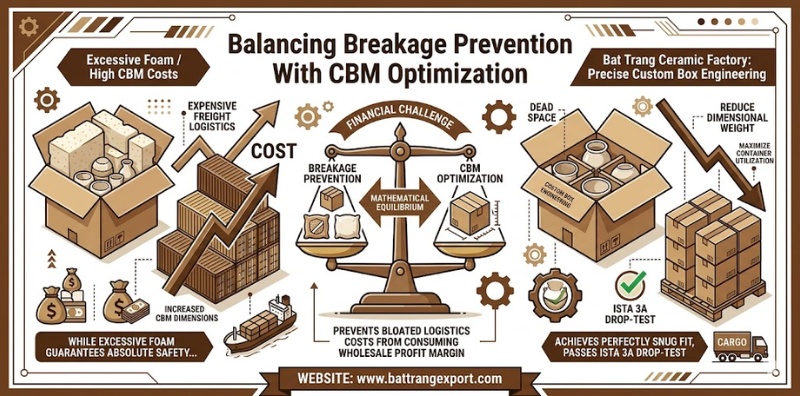
Bat Trang Ceramic Factory solves this complex financial equation through highly precise custom box engineering. Specifically, our logistics team designs internal packaging that achieves a perfectly snug fit around the specific ceramic merchandise.
By eliminating unnecessary internal dead space, we drastically reduce the overall dimensional weight of the master cartons. In addition, this highly optimized engineering approach successfully passes the rigorous ISTA 3A drop-test while maximizing your overall container utilization.
Container Loading: Securing Cargo For Ocean Freight
The final phase of export logistics occurs directly at the factory when technicians load the finalized pallets into the steel shipping container. Executing this step correctly requires calculating precise weight distribution across the floor of the 20ft or 40ft container.
Unevenly distributed weight can cause catastrophic container instability during the mechanical lifting procedures at the departure terminal. Therefore, experienced logistics operators systematically balance the heavy ceramic pallets to ensure perfectly stable marine transportation.
To eliminate any horizontal shifting, workers strategically insert inflatable dunnage air bags into the empty voids between the pallets. Consequently, these pressurized air bags lock the cargo firmly in place, neutralizing violent mechanical forces generated by severe ocean swells and unpredictable maritime storms.
Breakage Allowances and Factory Logistics Guarantees
Despite implementing the most advanced packaging technology available, navigating global maritime logistics always carries inherent environmental risks. Specifically, extreme weather conditions and violent terminal handling occasionally exceed the maximum protective tolerances of standard industrial packaging.
Because these external logistical variables remain uncontrollable, the international ceramic industry widely accepts a minor breakage rate of 1% to 3%.
To proactively mitigate risks in large-volume ceramic manufacturing and exporting, B2B importers must incorporate this standard 1% to 3% statistical breakage allowance directly into their financial procurement calculations, establishing a vital contingency plan against uncontrollable maritime weather conditions
To completely secure your financial investment, integrating a transparent replacement credit policy into a highly structured, professional ordering process for bulk ceramic exports ensures that our commercial contracts formally guarantee financial compensation if maritime transit damage definitively exceeds standard industry allowances.
Consequently, if the transit damage definitively exceeds this standard industry allowance, we formally guarantee financial compensation for the excess broken inventory.
We confidently deliver these comprehensive turnkey packaging solutions to actively protect our global B2B partnerships. By assuming full responsibility for these critical logistical engineering challenges, we ensure your bulk ceramic imports arrive safely and remain highly profitable.
In conclusion, executing a rigorous structural packaging protocol serves as an impenetrable shield that actively defends your enterprise’s financial profit margins. By strictly adhering to international drop-test standards and ISPM-15 regulations, B2B buyers can completely eliminate catastrophic transit losses. Contact Bat Trang Ceramic Factory today to secure a highly resilient export manufacturing project backed by flawless logistical execution!