
Global Quality Standards for Ceramic Exports: US, EU, and Japan Compliance
Global ceramic export quality standards represent strict legal frameworks designed to control heavy metal leaching from Food Contact Materials (FCM). Specifically, these mandatory regulations protect international consumers by ensuring that toxic substances never migrate from pottery surfaces into consumable food or beverages.
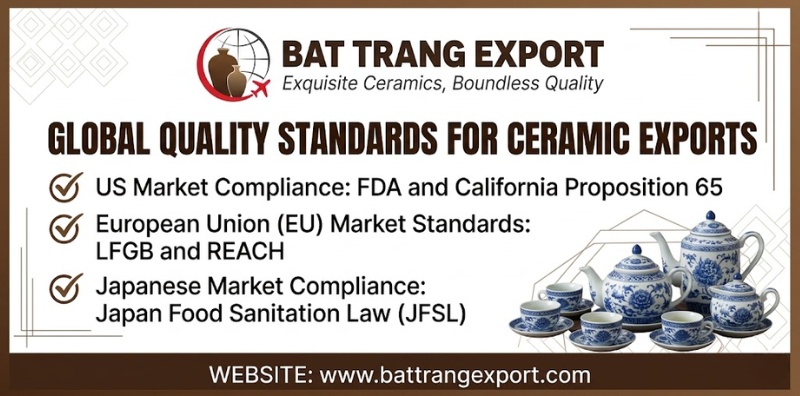
Bat Trang Ceramic Factory consistently complies with these rigorous legal requirements across the highly regulated US, EU, and Japanese markets. Consequently, our proactive adherence to international law guarantees smooth customs clearance and eliminates supply chain disruptions for our global B2B partners.
US Market Compliance: FDA and California Proposition 65
Entering the United States requires strict adherence to federal and state-level safety regulations. Importers must navigate two distinct legal frameworks to ensure completely lawful distribution across the country.
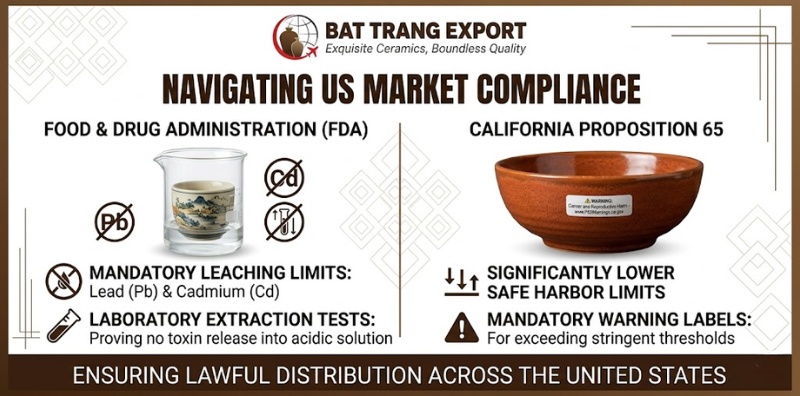
- Food and Drug Administration (FDA): The FDA governs Food Contact Materials at the national level, establishing mandatory leaching limits for lead and cadmium. Consequently, all imported ceramics must pass strict laboratory extraction tests to prove they do not release dangerous toxins into an acidic solution.
- California Proposition 65: Selling products within California requires strict compliance with this specific state law, which enforces significantly lower safe harbor limits than the federal FDA guidelines. Furthermore, if a ceramic product exceeds these stringent thresholds, the manufacturer must legally attach specific warning labels regarding potential chemical exposure.
European Union (EU) Market Standards: LFGB and REACH
The European Union enforces some of the most demanding consumer safety protocols globally. Therefore, suppliers must satisfy comprehensive testing parameters to legally penetrate this highly regulated commercial zone.
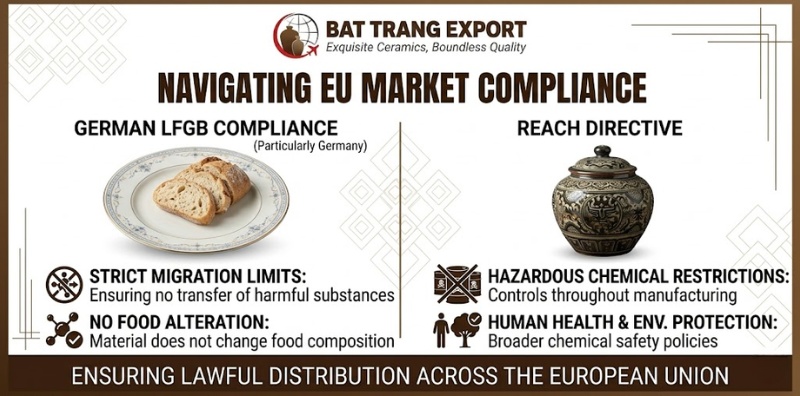
- German LFGB Compliance: Products entering the EU, particularly Germany, must pass the rigorous German LFGB testing protocols. Specifically, these regulations mandate strict migration limits, ensuring that the ceramic material does not transfer harmful substances to food or negatively alter its composition.
- REACH Directive: In addition to food safety, the European Commission requires strict adherence to the REACH directive regarding broader chemical regulations. This comprehensive policy restricts the use of hazardous chemicals throughout the manufacturing process, effectively protecting human health and the environment.
Failing to comply with EU directives can lead to blocked shipments and catastrophic product recalls. Establishing strict QA protocols based on these global standards is a fundamental strategy to mitigate risks in large-volume ceramic manufacturing and protect your brand from severe financial liabilities.
Japanese Market Compliance: Japan Food Sanitation Law (JFSL)
The Japanese market imposes uniquely demanding quality requirements for all imported tableware. Specifically, the Ministry of Health, Labour and Welfare (MHLW) enforces the Japan Food Sanitation Law (JFSL) to maintain strict hygiene standards nationwide.
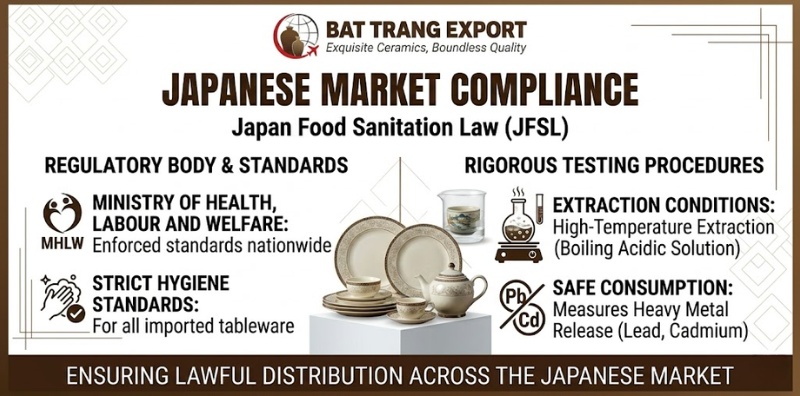
Under this legislation, ceramic products must undergo rigorous testing under highly specific extraction conditions, often involving boiling acidic solutions. Consequently, this high-temperature extraction test precisely measures the release of heavy metals, proving the items are absolutely safe for daily consumer use.
Global System Certifications and Corporate Social Responsibility
Beyond product safety, international B2B buyers demand transparent and ethical manufacturing operations. Therefore, partnering with a certified facility minimizes supply chain risks and ensures long-term operational stability.
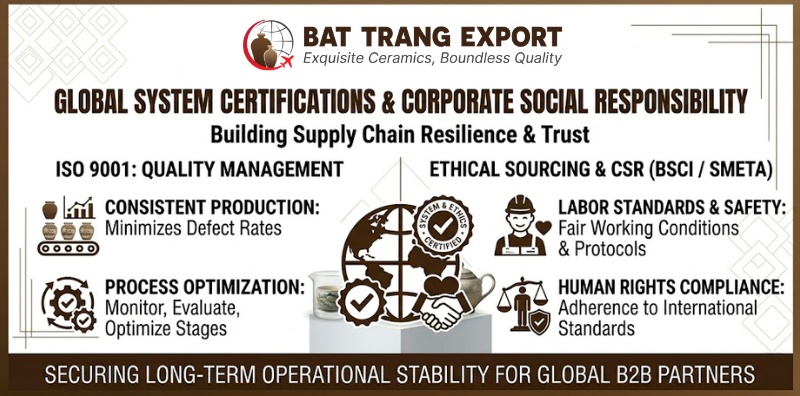
- ISO 9001: Quality Management Systems (QMS): Implementing a robust Quality Management System ensures consistent production output and strictly minimizes defect rates. Consequently, this internationally recognized certification demonstrates a factory’s structural capability to monitor, evaluate, and continuously optimize every stage of the manufacturing process.
- Ethical Sourcing (BSCI and Sedex SMETA Audits): Major supermarket chains in Europe and the US strictly require suppliers to maintain high labor standards and corporate social responsibility. In addition, participating in comprehensive ethical audits guarantees fair working conditions, strict safety protocols, and absolute compliance with international human rights standards.
How Bat Trang Export Factory Ensures Food-Safe Ceramics
Transitioning from theoretical legal frameworks to practical manufacturing capabilities requires a heavily controlled production environment. Bat Trang Ceramic Factory actively enforces strict material handling protocols to guarantee total food safety.
– 100% Lead-Free and Cadmium-Free Glazes: We exclusively utilize rigorously tested, non-toxic mineral formulations for all export orders. By eliminating heavy metals at the raw material stage, we permanently prevent any hazardous chemical migration.
– High-Temperature Vitrification (>1200°C): Our facility fires all ceramics in advanced gas kilns at extremely high temperatures. Consequently, this intense thermal process completely vitrifies the glaze layer, securely locking all internal minerals and creating an impenetrable, food-safe glass surface.
Third-Party Laboratory Testing and Certification
To objectively prove legal compliance, Bat Trang Ceramic Factory collaborates closely with globally accredited third-party testing agencies, including SGS, Intertek, and TUV. We routinely submit physical production samples to these independent laboratories prior to authorizing any international shipment.
These rigorous external audits generate transparent test reports that definitively validate our internal quality control metrics. Furthermore, supplying these official compliance certificates directly to customs authorities significantly accelerates the international clearance process for our B2B clients.
The Process of Obtaining and Verifying Quality Certifications
Securing an official product testing report follows a highly standardized workflow to guarantee total objectivity and scientific accuracy.
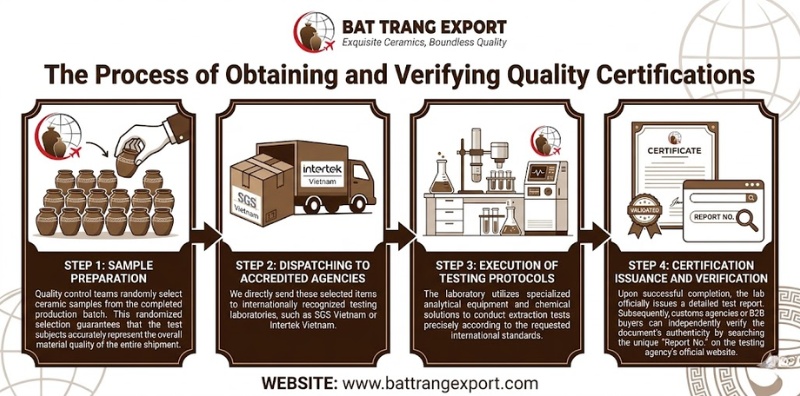
- Step 1: Sample Preparation: Quality control teams randomly select ceramic samples from the completed production batch. This randomized selection guarantees that the test subjects accurately represent the overall material quality of the entire shipment.
- Step 2: Dispatching to Accredited Agencies: We directly send these selected items to internationally recognized testing laboratories, such as SGS Vietnam or Intertek Vietnam.
- Step 3: Execution of Testing Protocols: The laboratory utilizes specialized analytical equipment and chemical solutions to conduct extraction tests precisely according to the requested international standards.
- Step 4: Certification Issuance and Verification: Upon successful completion, the lab officially issues a detailed test report. Subsequently, customs agencies or B2B buyers can independently verify the document’s authenticity by searching the unique “Report No.” on the testing agency’s official website.
Passing the laboratory tests is only half the battle; presenting these compliance certificates at the destination border is mandatory. You must integrate these lab reports into the broader ceramic export customs procedures in Vietnam to ensure all essential documents are ready for a smooth clearance.
How to Read and Understand a Quality Test Report
When reviewing a compliance certificate, importers must carefully examine specific data points to confirm legal validity.
- Applicant: This field must display the exact name of the manufacturing facility or the official exporting entity.
- Sample Description: The document must feature clear photographs, precise product names, and item codes that perfectly match the actual physical shipment.
- Test Requested: This section clearly specifies the applied legal standard, such as EU Regulation (EC) No 1935/2004 or FDA guidelines.
- Result: Buyers must systematically compare the “Actual Result” column against the “Limit” column. Specifically, the actual extraction data must remain strictly below the legally permissible thresholds.
- Conclusion: This final assessment section must explicitly state the word “PASS” to confirm total regulatory compliance.
- Signatures and Seals: The report requires the complete authorized signatures and official stamps from the testing laboratory’s executive personnel.
As consumer safety laws become increasingly strict worldwide, adapting to these US, EU, and Japanese regulations is critical for your brand’s global expansion. In fact, these compliance-driven regions are projected to remain the top global markets for importing Vietnamese ceramics well into 2026.
Navigating complex international legal frameworks requires a reliable manufacturing partner with deep expertise in global quality standards. Bat Trang Ceramic Factory consistently guarantees that every bulk order strictly complies with all US, EU, and Japanese safety regulations. Contact our technical sales team today to request a comprehensive quotation and secure fully certified, food-safe ceramics for your wholesale business!