
How to Calculate Export Ceramic Prices: Cost Breakdown & Influencing Factors
Securing an accurate wholesale quotation requires B2B importers to thoroughly understand the underlying cost structures of international procurement. By analyzing the fundamental variables that dictate unit prices, procurement managers can accurately forecast their total landed costs.
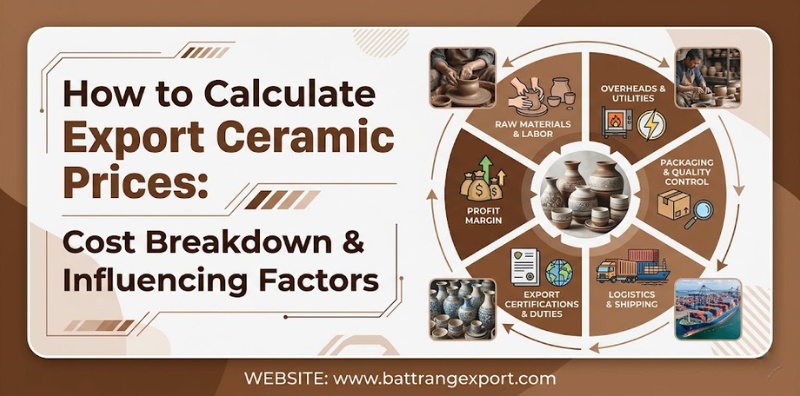
In this comprehensive guide, Bat Trang Ceramic Factory breaks down the specific financial factors impacting your final export quotation. We meticulously analyze everything from direct manufacturing variables to mandatory export fees, helping you optimize your global sourcing budget effectively.
Direct Factors Influencing Ceramic Manufacturing Costs
Calculating the base ex-factory price involves evaluating several core production variables before factoring in logistics. Understanding these internal manufacturing metrics allows buyers to make informed financial decisions regarding their specific product requirements.
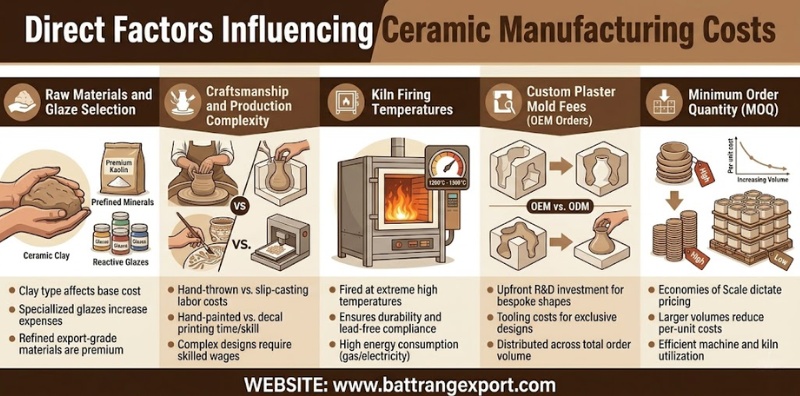
- Raw Materials and Glaze Selection: The specific type of clay, such as premium porcelain or kaolin, alongside specialized finishes like reactive glazes, primarily dictates the base material cost. Furthermore, export-grade ceramics strictly require highly refined, toxin-free minerals, which inherently carry a higher market premium.
- Craftsmanship and Production Complexity: Hand-thrown structural designs naturally incur higher labor costs compared to automated slip-casting methods. Similarly, evaluating the labor economics of hand-painted vs. decal printing on ceramics is crucial, as intricate artisanal patterns demand significantly more production time and skilled hourly wages than applying automated high-temperature transfers.
- Kiln Firing Temperatures: To achieve absolute lead-free compliance and maximum mechanical durability, manufacturers must fire export ceramics at extreme temperatures ranging from 1200°C to 1300°C. Consequently, this intensive oxidation or reduction firing process consumes massive amounts of gas or electricity, directly increasing the final unit price.
- Custom Plaster Mold Fees (OEM Orders): When calculating upfront R&D investments, understanding the financial differences between OEM vs. ODM in ceramic manufacturing helps buyers strictly decide whether to engineer bespoke plaster molds for exclusive shapes or eliminate tooling costs entirely by leveraging factory blanks. However, manufacturers routinely distribute this one-time tooling expense across the total order volume, effectively reducing its impact on the individual unit price.
- Minimum Order Quantity (MOQ): The fundamental economic principle of economies of scale heavily dictates wholesale ceramic pricing. Therefore, larger order volumes drastically reduce the per-unit operational costs regarding machine utilization, labor efficiency, and kiln capacity.
Export-Specific Costs For Global Ceramic Sourcing
Transitioning manufactured goods across international borders introduces additional regulatory and protective expenses. Importers must incorporate these mandatory export-specific costs into their financial models to avoid unexpected budget overruns:
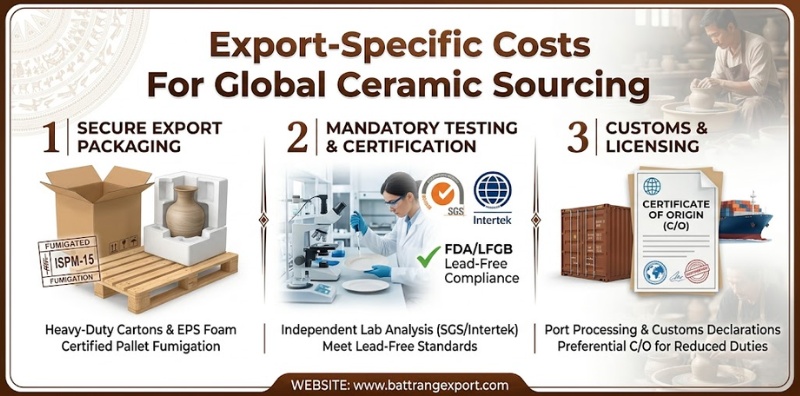
- Export Packaging Standards: Fragile cargo requires heavy-duty 5-ply to 7-ply corrugated cartons and specialized EPS foam inserts for maximum transit protection. In addition, international agricultural laws strictly mandate costly ISPM-15 fumigation procedures for all wooden shipping pallets.
- Testing and Certification: Highly regulated international markets demand independent laboratory testing from agencies like SGS or Intertek. Because non-compliant cargo faces immediate customs rejection, paying independent laboratories to verify strict global quality standards for ceramic exports—such as FDA or LFGB lead-free parameters—constitutes a mandatory and non-negotiable administrative expense.
- Customs and Export Licensing: Executing the physical export requires paying standardized fees for port processing and customs declarations. Besides standard clearance, applying for a Preferential Certificate of Origin (C/O) incurs minor administrative costs but saves buyers massive amounts in destination import duties.
How Incoterms Determine Your Final Export Quotation
A commercial quotation remains incomplete without clearly defining the agreed International Commercial Terms (Incoterms). These universally recognized legal frameworks determine exactly where the manufacturer’s financial responsibility ends and the buyer’s liability begins.
- EXW (Ex-Works): This baseline pricing structure only covers the direct manufacturing cost and standard factory packaging. Consequently, the buyer assumes total financial responsibility for all inland trucking, customs clearance, and ocean freight logistics from the factory door.
- FOB (Free On Board): This remains the most widely utilized pricing metric for B2B ceramic imports. The FOB quote equals the EXW price plus inland transportation to the departure port, export customs clearance, and terminal handling charges (THC).
- CIF (Cost, Insurance, and Freight): This comprehensive structure encompasses the entire FOB value while adding the cost of maritime insurance and the ocean freight charges to the final destination port.
Besides these three primary terms, buyers occasionally negotiate Delivery Duty Paid (DDP) or Delivered at Place (DAP) structures depending on their logistical capabilities. However, the standard FOB price consistently serves as the most critical reference point for international importers calculating their total landed costs.
Tips To Optimize Your Wholesale Ceramic Budget
Proactive procurement managers utilize specific operational strategies to negotiate better pricing structures without sacrificing material quality. Implementing the following supply chain tactics will significantly optimize your overall wholesale purchasing budget:
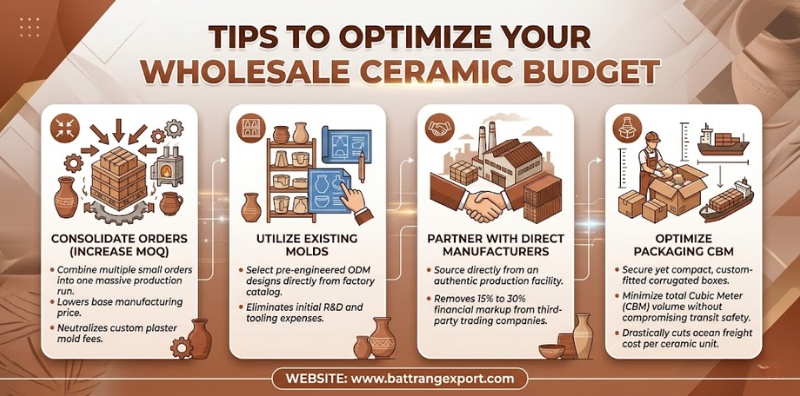
- Consolidate Orders (Increase MOQ): Combining multiple smaller purchase orders into one massive production run drastically lowers the base manufacturing price. Furthermore, this volume consolidation effectively neutralizes custom plaster mold fees.
- Utilize Existing Molds: Selecting pre-engineered ODM designs directly from the factory’s established catalog completely eliminates all initial R&D and tooling expenses.
- Partner with Direct Manufacturers: Sourcing directly from an authentic production facility instantly removes the 15% to 30% financial markup typically charged by third-party trading companies.
- Optimize Packaging CBM: While you must instruct the factory on how to securely package ceramic orders for export to prevent breakage, simultaneously engineering compact, custom-fitted corrugated boxes significantly reduces the total Cubic Meter (CBM) volume without compromising physical transit safety. Therefore, maximizing the container’s internal space drastically cuts down the ocean freight cost per individual ceramic unit.
Essential Information Needed For An Accurate Factory Quotation
Manufacturers require a highly detailed technical dossier to calculate an exact commercial quotation efficiently. By integrating a comprehensive Tech Pack into a highly structured, professional ordering process for bulk ceramic exports, procurement managers can immediately eliminate pricing ambiguities, accurately lock in Incoterms, and drastically accelerate the entire contract negotiation phase.
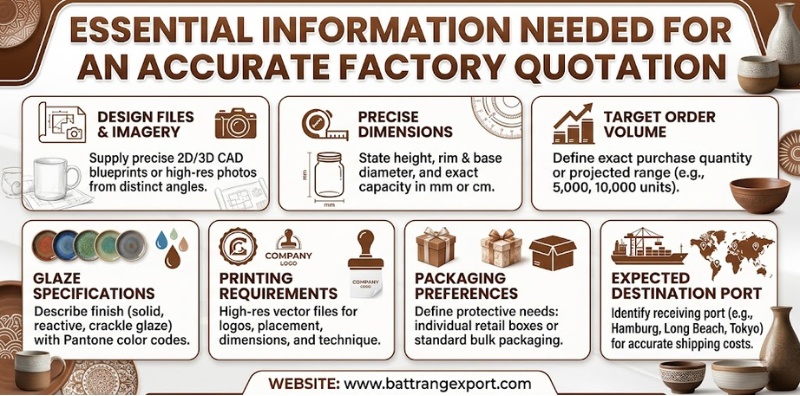
- Design Files and Imagery: Supply precise 2D/3D CAD blueprints or high-resolution photographs displaying the physical product from multiple distinct angles.
- Precise Dimensions: Explicitly state the required height, rim diameter, base diameter, and exact liquid capacity using standard millimeters or centimeters.
- Target Order Volume: Define the exact purchase quantity or provide the projected volume range, such as 5,000, 10,000, or 20,000 units.
- Glaze Specifications: Clearly describe the desired finish, indicating whether the project requires a solid color, reactive glaze, or crackle effect, alongside specific Pantone color codes.
- Printing Requirements: Provide high-resolution vector files for customized logos, indicating the exact placement, dimensions, and preferred application technique like high-temperature decals or laser engraving.
- Packaging Preferences: Outline the exact protective requirements, specifying whether the order needs individual retail gift boxes or standard industrial bulk packaging.
- Expected Destination Port: Identify the final receiving port, such as Hamburg, Long Beach, or Tokyo, enabling the logistics team to calculate accurate CIF shipping costs.
Preparing these comprehensive technical details upfront will significantly accelerate the administrative timeline and guarantee the most precise financial quotation possible.
Transparent Export Pricing At Bat Trang Ceramic Factory
Bat Trang Ceramic Factory operates as a fully integrated, direct manufacturing facility capable of handling massive wholesale export volumes. We systematically control every production phase from raw clay processing to final ISPM-15 packaging, entirely bypassing unnecessary middleman markups.
We strictly commit to absolute financial transparency by providing highly detailed, itemized commercial quotations. Consequently, our B2B clients see the exact cost breakdown for raw materials, plaster molds, and export packaging, ensuring zero hidden fees.
Furthermore, our experienced logistics team proactively assists buyers in calculating the exact Cubic Meter (CBM) volume before mass production begins. This strategic CBM optimization guarantees maximum container utilization, drastically lowering your total international shipping expenses.
To validate our competitive pricing models, we offer rapid physical prototyping services for all custom OEM projects. This efficient sampling phase allows international buyers to rigorously test our structural quality and glaze accuracy before committing to a substantial financial contract.
In conclusion, mastering the diverse variables of wholesale ceramic pricing empowers international buyers to optimize their global procurement budgets effectively. Consequently, partnering with Bat Trang Ceramic Factory ensures you receive fully transparent, itemized quotations that systematically eliminate unexpected export costs. Contact our dedicated sales team today with your comprehensive Tech Pack to secure highly competitive manufacturing rates for your next B2B sourcing project!