
How to Mitigate Risks in Large-Volume Ceramic Manufacturing and Exporting
Sourcing large-volume export ceramics inherently involves substantial risks that can trigger severe financial losses and damage brand reputation. Therefore, executing a comprehensive risk management strategy is absolutely critical for B2B importers managing complex international supply chains.
In this guide, Bat Trang Export Factory thoroughly addresses five primary manufacturing threats while providing actionable mitigation tactics. Furthermore, we outline our proprietary risk management protocol to ensure complete peace of mind when placing massive commercial orders.
1. Controlling Glaze Variations and Structural Defect Rates
International buyers frequently expect tens of thousands of ceramic units to be identical, treating them like injection-molded plastics. In reality, extreme kiln temperature fluctuations inevitably cause minor glaze variations, while natural clay shrinkage leads to structural warping.
Consequently, failing to manage these physical variables results in unacceptable defect rates and rejected inventory. To systematically mitigate these structural and aesthetic inconsistencies, importers must enforce the following strict quality control measures:
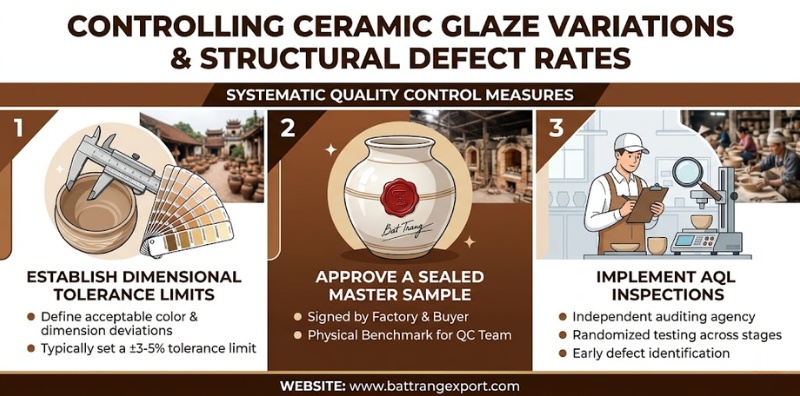
- Establish Dimensional Tolerance Limits: Both parties must sign a commercial appendix clearly defining acceptable deviations in color matching, utilizing Pantone codes, and structural dimensions, typically setting a ±3-5% tolerance limit.
- Approve a Sealed Master Sample: The factory and the buyer must retain a finalized, physically sealed master prototype bearing official signatures. Consequently, this physical benchmark serves as the ultimate reference for the internal Quality Control (QC) team during mass production.
- Implement AQL (Acceptable Quality Limit) Inspections: Hire an independent auditing agency to conduct randomized AQL testing across multiple stages of the complete Bat Trang ceramic manufacturing process, ensuring that early defect identification—from the initial bisque firing to the final glaze application—forces the manufacturer to execute immediate corrective actions before mass carton packaging.
2. Ensuring Legal Compliance: Food Safety and Customs Rejection
Severe legal risks emerge when imported ceramic tableware is identified with hazardous heavy metal leaching, particularly lead or cadmium. If US or EU customs authorities detect toxic contamination, they will immediately destroy the entire container and impose strict import bans.
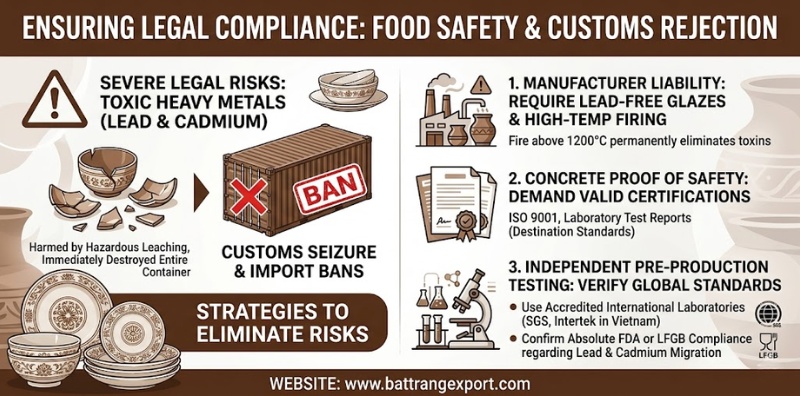
To eliminate this critical legal threat, importers must demand concrete proof of material safety, such as ISO 9001 certifications and official laboratory test reports matching destination market standards. Besides requesting standard documentation, buyers must actively enforce these specific compliance strategies:
- Demand Manufacturer Liability: The commercial contract must explicitly bind the factory to utilize 100% lead-free glazes. In addition, the facility must fire products above 1200°C to permanently eliminate all toxic heavy metals from the material matrix.
- Conduct Independent Pre-Production Testing: Never rely solely on outdated test reports previously provided by the manufacturer. Instead, randomly select items from the initial firing batch and submit them to accredited international laboratories in Vietnam, such as SGS or Intertek, to verify strict adherence to global quality standards for ceramic exports, empirically confirming absolute FDA or LFGB compliance regarding lead and cadmium migration.
3. Preventing Transit Breakage in Ocean Freight Logistics
The most prominent physical threat in global sourcing is a high breakage rate during maritime transportation. Turbulent ocean waves and aggressive container handling at port terminals generate severe mechanical shocks that easily destroy fragile cargo.
Because securing your physical inventory requires resilient infrastructure to absorb catastrophic maritime impacts, B2B buyers must explicitly instruct the facility on exactly how to package ceramic orders for export to prevent breakage, implementing strict logistical safeguards such as multi-ply master cartons and molded EPS foam.
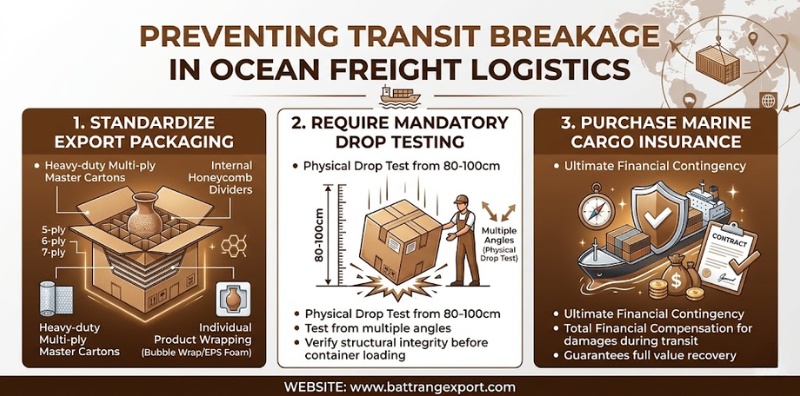
- Standardize Export Packaging: Require the use of heavy-duty 5-ply to 7-ply master cartons equipped with internal honeycomb cardboard dividers. Furthermore, factory workers must wrap each individual product in bubble wrap or secure them inside molded EPS foam.
- Require Mandatory Drop Testing: Before finalizing container loading, the facility must execute a physical drop test on a fully packed carton from a standard height of 80-100cm across multiple angles. This procedure empirically verifies the structural integrity and protective capability of the external packaging.
- Purchase Marine Cargo Insurance: This acts as your ultimate financial contingency plan against catastrophic environmental variables. Consequently, comprehensive insurance guarantees total financial compensation if your cargo suffers unpredictable damage during ocean transit.
4. Mitigating Production Delays and Kiln Scheduling Bottlenecks
Ceramic production fundamentally resists rapid acceleration because it depends entirely on strict kiln firing cycles and greenware drying phases. Furthermore, placing massive commercial orders during peak sourcing seasons or directly before the Lunar New Year inevitably triggers severe lead time delays.
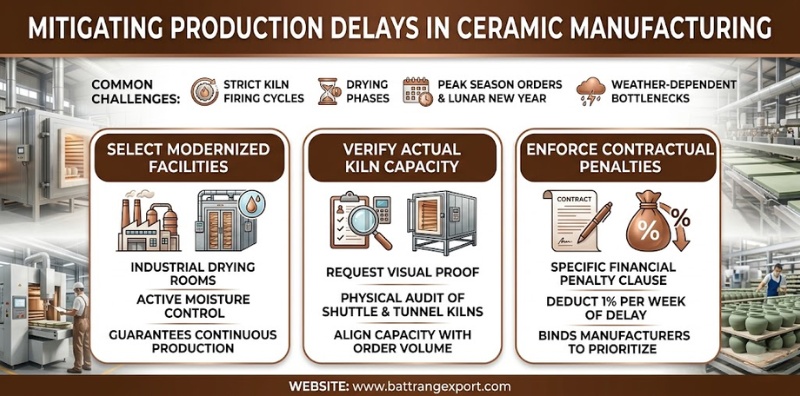
Relying on weather-dependent facilities introduces unpredictable supply chain bottlenecks that disrupt your global retail schedule. Therefore, mitigating production delays requires buyers to verify capacity and enforce accountability through these methods:
- Select Modernized Facilities: Prioritize partnering with manufacturers equipped with industrial drying rooms to actively control the greenware moisture removal process. This advanced technology guarantees continuous production without relying on unpredictable weather conditions.
- Verify Actual Kiln Capacity: Request visual proof or conduct a physical audit to confirm the active operational status of their shuttle kilns or tunnel kilns. Consequently, this data allows you to accurately calculate if their true manufacturing capacity aligns with your specific order volume.
- Enforce Contractual Penalty Clauses: Insert a specific financial penalty clause into the commercial agreement, such as deducting 1% of the contract value for every week of delayed delivery. This legally binds the manufacturer to strictly prioritize your production schedule.
5. Protecting Intellectual Property (IP) in OEM Sourcing
Commercial IP vulnerabilities exclusively arise when clients bypass factory blanks and choose to invest heavily in exclusive R&D. By thoroughly understanding the distinct risk profiles associated with OEM vs. ODM in ceramic manufacturing, buyers can implement proactive legal barriers to prevent unauthorized factories from selling their bespoke, custom-sculpted designs to direct retail competitors.
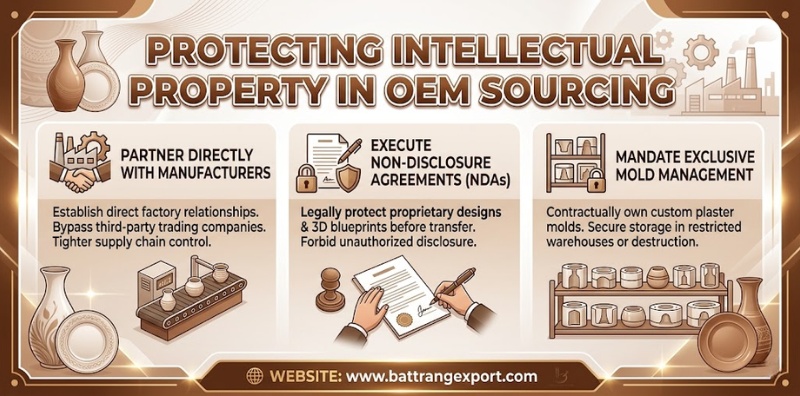
Preventing unauthorized distribution requires establishing a legally secure perimeter around your proprietary 3D blueprints. Consequently, international buyers must execute these protective protocols:
- Partner Directly with Manufacturers: Avoid utilizing third-party trading companies that lack their own production facilities. Bypassing middlemen drastically reduces the number of entities accessing your sensitive design files, thereby tightening overall supply chain control.
- Execute Non-Disclosure Agreements (NDAs): Before transferring any technical blueprints or 3D CAD models, force the factory to sign a legally binding NDA. This international agreement explicitly forbids the manufacturer from disclosing or repurposing your designs for external commercial purposes.
- Mandate Exclusive Mold Management: Clearly stipulate the legal ownership of all custom plaster molds directly within the contract. Require the factory to securely store these assets in a restricted warehouse or systematically destroy them upon project completion.
Risk Management Process for Export Orders at Bat Trang Ceramic Factory
With over 15 years of experience managing ceramic production and exporting to highly regulated markets like Japan and Europe, we have developed a highly effective risk management protocol. This structured system does not just react to problems as they arise, but actively neutralizes them directly at the source.
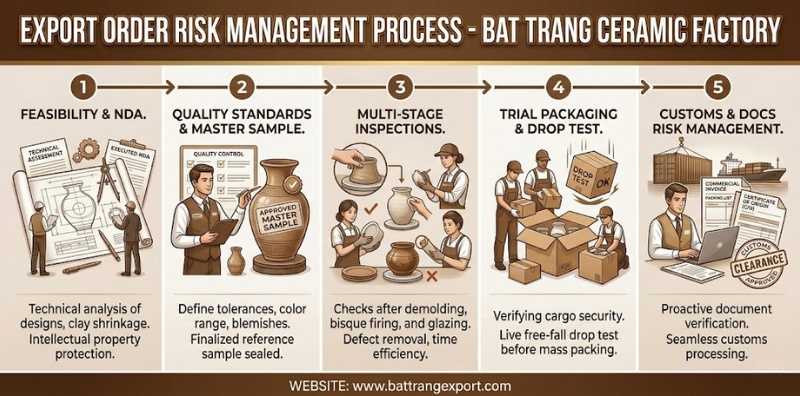
- Step 1: Feasibility Assessment & NDA Execution: Before accepting any financial deposit, our engineering department analyzes your blueprints to assess technical feasibility regarding clay shrinkage and glaze stability. Subsequently, both parties execute a strict NDA to protect your intellectual property.
- Step 2: Establishing Quality Standards & Sealing Samples: We document and mutually agree upon all critical parameters, including dimensional tolerances, acceptable color variations, and permissible surface blemishes. A finalized master sample is physically sealed, providing an absolute reference benchmark for both the client and our facility.
- Step 3: Multi-Tiered Production Inspections: Instead of waiting for final assembly, our internal QC team continuously inspects critical phases: after demolding, following the bisque firing, and post-glazing. Defective units are discarded immediately to ensure the overall production timeline remains completely unaffected.
- Step 4: Trial Packaging & Live Drop Testing: Prior to mass packaging, we pack a trial carton according to the agreed specifications and execute a live free-fall drop test. This empirical procedure guarantees the cargo remains 100% secure before container loading procedures begin.
- Step 5: Customs & Documentation Risk Management: Our export logistics department prepares and submits all draft documents, including the Commercial Invoice, Packing List, and C/O, for client approval. This proactive verification eliminates administrative errors before transmitting the official customs declaration, ensuring seamless port clearance.
Bat Trang Export Factory – Your Reliable Partner for Ceramic Sourcing
At Bat Trang Ceramic Factory, we engineer absolute peace of mind for international B2B importers navigating complex supply chains. We fundamentally understand that every bulk order represents a critical commitment to your brand’s reputation and financial stability.
Our tangible manufacturing capacity is proven by our expansive 500-square-meter facility, equipped with multiple high-capacity kilns and modernized industrial drying rooms. This advanced infrastructure allows us to maintain a stable output of 50,000 to 100,000 units per month, guaranteeing strict schedule adherence without weather-related disruptions.
Furthermore, we enforce rigorous legal and quality commitments across all production lines. Every ceramic product undergoes strict laboratory testing to ensure total compliance with global FDA and REACH standards, and we confidently guarantee 100% financial compensation if any delivered inventory exhibits manufacturer-originated defects.
Finally, securing your physical investment through professional packaging remains our highest logistical priority. We engineer all export packaging to pass rigorous drop tests while providing fully compliant ISPM-15 wooden pallet fumigation, ensuring your wholesale cargo arrives safely and perfectly intact.
In conclusion, executing strict risk mitigation strategies transforms a highly vulnerable supply chain into a highly stable and profitable procurement engine. Consequently, maintaining absolute control over kiln schedules, legal compliance, and protective packaging ensures your massive commercial investments remain secure. Contact Bat Trang Ceramic Factory today with your technical specifications to initiate a completely transparent and risk-free manufacturing project!