
The Ultimate Beginner’s Guide to Source Wholesale Bat Trang Ceramics
Sourcing wholesale ceramics requires international buyers to thoroughly understand technical manufacturing variables and specific pricing structures. Bat Trang serves as a prominent production hub, yet beginners must acquire fundamental engineering knowledge to successfully navigate potential supply chain risks.
Therefore, this comprehensive guide provides essential strategies to evaluate supplier capabilities, manage technical production hazards, and negotiate commercial contracts effectively. Bat Trang Export actively guides new importers through every critical phase, ensuring a highly transparent and predictable B2B sourcing experience.
Identifying Authentic Manufacturers: Real Factories vs. Trading Companies
Collaborating directly with an authentic ceramic manufacturer significantly enhances quality control while optimizing unit costs and production timelines. However, beginners often mistake retail showrooms or trading companies for actual production facilities. To accurately identify a direct factory, procurement managers should verify the following operational indicators:
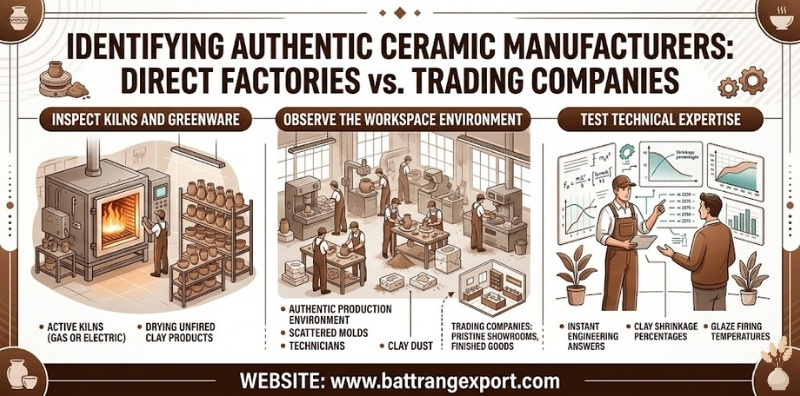
- Inspect Greenware and Kilns: A legitimate manufacturer will readily showcase their active gas or electric kilns alongside drying greenware, which consists of unfired clay products.
- Observe the Workspace Environment: Authentic production environments naturally feature scattered plaster molds, raw clay dust, and active technicians operating machinery. Conversely, trading companies typically present pristine showrooms focused entirely on finished goods displays.
- Test Technical Expertise: Direct factory managers can instantly answer complex engineering questions regarding exact clay shrinkage percentages or specific glaze firing temperatures without hesitation.
Smart Negotiation Strategies for Custom Mold Costs
Many first-time importers experience surprise upon receiving quotations that include mandatory plaster mold development fees for custom shapes. By understanding the core financial differences between OEM vs. ODM in ceramic manufacturing, buyers can decide whether to invest in these necessary R&D costs for bespoke designs or utilize smart negotiation strategies to optimize their procurement budget.
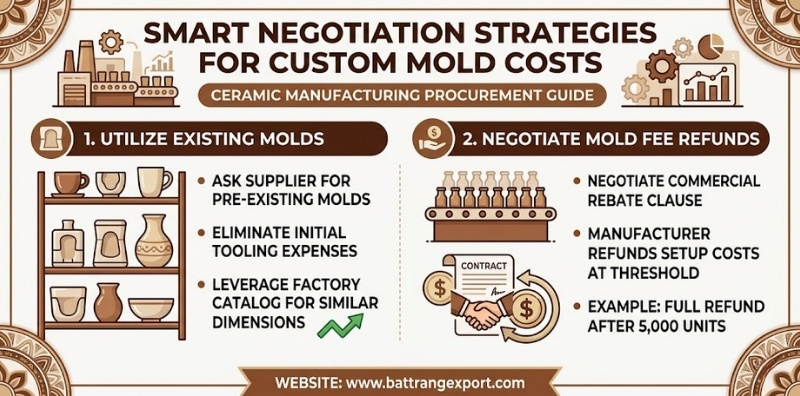
- Utilize Existing Molds: If your project does not require strict structural exclusivity, ask the supplier if they possess pre-existing molds with similar dimensions. Consequently, leveraging an established factory catalog completely eliminates initial tooling expenses.
- Negotiate Mold Fee Refunds: For large-scale custom orders, buyers should negotiate a commercial rebate clause directly within the contract. Specifically, the manufacturer commits to fully refunding the mold setup costs once your cumulative order volume reaches a predefined threshold, such as 5,000 units.
Understanding Technical Ceramic Variables: Shrinkage and Glaze Risks
Unlike synthetic plastic molding, raw clay and mineral glazes undergo intense physical transformations during the high-temperature firing process. B2B buyers must understand these natural material behaviors to establish realistic tolerance limits within their technical specifications.
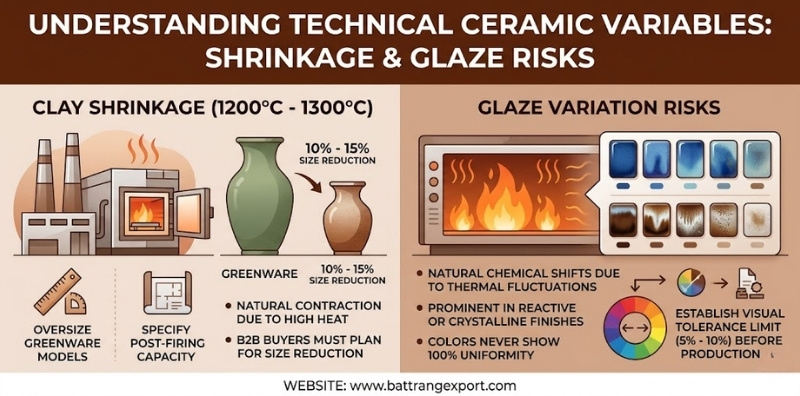
- Clay Shrinkage: When fired at high temperatures ranging from 1200°C to 1300°C, the clay body naturally contracts by 10% to 15% from its original size. Therefore, buyers must explicitly state the desired post-firing capacity in their blueprints, allowing the engineers to deliberately oversize the initial greenware models.
- Glaze Variation Risks: Ceramic glaze colors never exhibit 100% absolute uniformity because slight thermal fluctuations inside the kiln create natural chemical shifts. This unpredictable phenomenon is particularly prominent when utilizing reactive or crystalline finishes. Exploring the common types of ceramic glazes for export orders helps clients comprehend these natural chemical shifts, allowing them to establish a predefined visual tolerance limit of approximately 5% to 10% before approving mass production.
Securing Production Timelines and the “Shared Kiln” Factor
Manufacturing lead times heavily depend on overall kiln capacity and the factory’s internal fuel efficiency strategies. For smaller order quantities, facilities often implement shared kiln scheduling, meaning they wait to consolidate multiple client orders into one massive gas kiln to optimize operational costs.
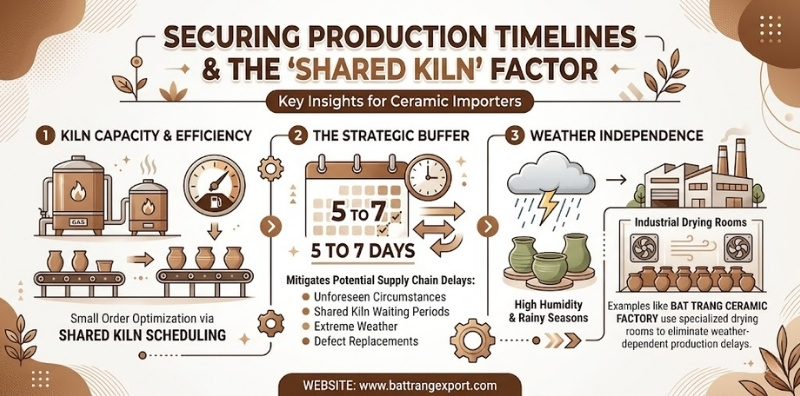
To mitigate potential supply chain delays, importers should consistently add a 5 to 7-day buffer to the officially contracted delivery date. This strategic buffer effectively accommodates unforeseen circumstances like shared kiln waiting periods, sudden extreme weather variations, or mandatory defect replacements.
Furthermore, buyers must verify how high humidity impacts the greenware drying phase during the rainy season. Fortunately, established manufacturers like Bat Trang Ceramic Factory utilize specialized industrial drying rooms, entirely eliminating weather-dependent production delays.
Establishing Defect Rates and Breakage Allowances
In mass production, minor kiln defects and transit damages represent inherent supply chain vulnerabilities rather than anomalies. Implementing strict contractual allowances is a fundamental strategy to mitigate risks in large-volume ceramic manufacturing and exporting, clearly defining financial accountability and ensuring smooth conflict resolution before loading the cargo.
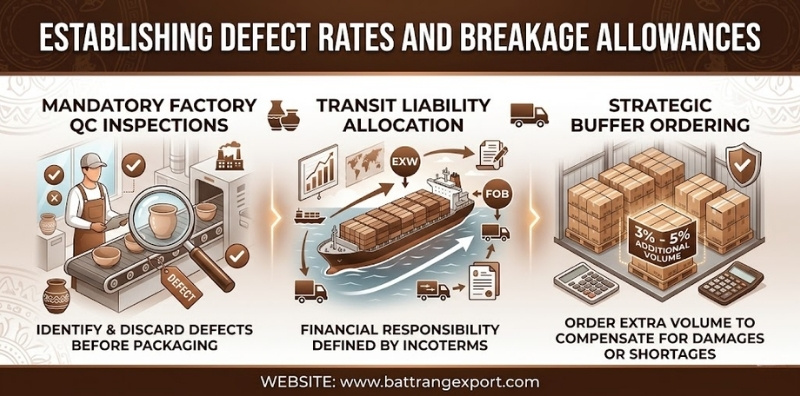
- Mandatory Factory QC Inspections: The commercial agreement must explicitly obligate the manufacturer to conduct rigorous internal quality control (QC) procedures. Therefore, the factory remains strictly responsible for identifying and discarding all defective units before the final export packaging stage.
- Transit Liability Allocation: Determining financial responsibility for ocean freight breakage depends entirely on the chosen shipping Incoterms. For instance, EXW terms place the risk on the buyer immediately after dispatch, whereas FOB terms require the factory to cover liabilities until the cargo safely loads onto the departing vessel.
- Strategic Buffer Ordering: Experienced procurement managers frequently order an additional 3% to 5% volume above their exact inventory requirement. This calculated surplus acts as a physical insurance policy, instantly compensating for any unexpected manufacturing shortages or logistical transit damages.
Why Bat Trang Ceramic Factory is Your Ideal Sourcing Partner?
Bat Trang Ceramic Factory operates a robust 500-square-meter facility fully equipped with modern machinery and specialized industrial drying rooms. Backed by 15 years of dedicated export manufacturing experience and a highly skilled workforce, we consistently execute complex wholesale orders. Consequently, partnering with our direct facility provides international B2B buyers with strategic commercial advantages that extend far beyond basic production.
- Transparent Cost Structures: By eliminating trading company markups, we provide factory-direct pricing with absolutely transparent commercial quotations. Furthermore, our dedicated account managers clearly outline all plaster mold fees, unit costs, and specific defect allowances upfront to optimize your overall procurement budget.
- Flexible OEM and ODM Capabilities: Our engineering team seamlessly accommodates both highly customized structural blueprints and rapid private-label branding projects. In addition, we actively consult clients on technical variables like clay shrinkage and high-temperature glaze stability to guarantee absolute manufacturing feasibility.
- Strict International Quality Compliance: We rigorously enforce Acceptable Quality Limit (AQL) standards to systematically eliminate defective units before final export packaging. Besides rigorous visual inspections, we guarantee that all utilized glazes are completely lead-free and non-toxic. This commitment ensures your products meet the strictest global quality standards for ceramic exports, entirely satisfying US FDA and European LFGB food safety regulations.
- Comprehensive Export Logistics Support: Navigating international supply chains requires precise logistical coordination and accurate customs documentation. Therefore, our facility directly handles critical export procedures, including ISPM-15 wooden pallet fumigation and seamless freight forwarder coordination, ensuring your cargo arrives safely and on schedule.
Mastering the technical variables of clay shrinkage, kiln scheduling, and defect allowances empowers new buyers to execute highly profitable international sourcing campaigns. By partnering directly with an authentic manufacturer, you actively eliminate middleman markups and secure absolute control over your product’s structural integrity. Contact Bat Trang Ceramic Factory today with your technical specifications to initiate a seamless, transparent, and highly efficient wholesale manufacturing project!